On this page
An alarm panel can link detection zones so that motion detectors and door contacts confirm one another within a confirmation window. The first activation remains visible in the event log, but it may not yet produce the full programmed response. This multiple alarm arrangement, usually called cross-zoning, answers a specific design question: when should separate detector signals be treated as convincing evidence of the same intrusion event?
What multiple alarm confirmation actually does
Cross-zoning is logic inside the alarm panel. Two or more independent zones are assigned a relationship. When one zone activates, the panel records the event and starts waiting for the required related activation. If the second zone responds under the configured conditions, the panel classifies the sequence as confirmed.
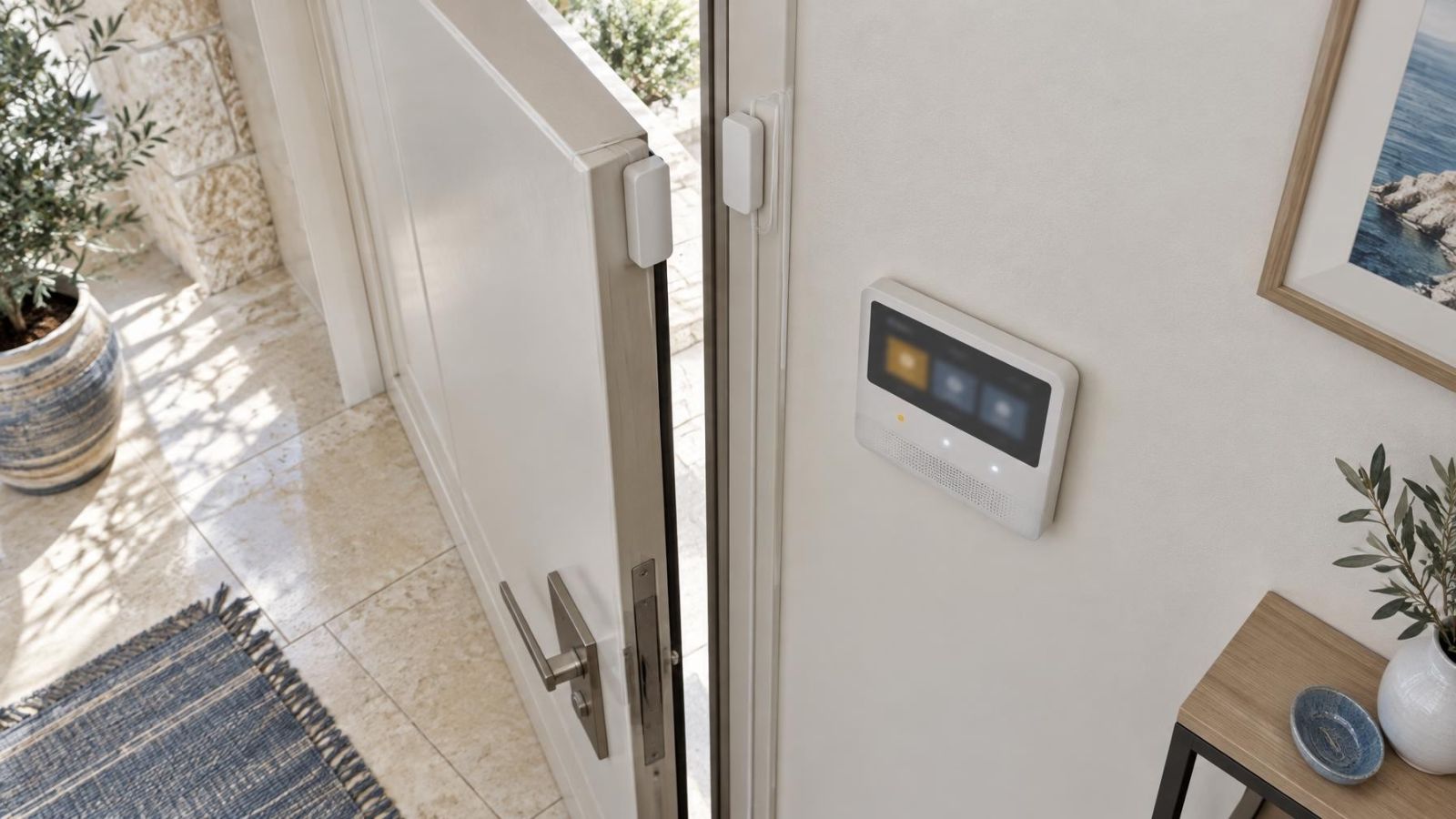
The important word is independent. Two zones are useful for confirmation when they observe different parts of a plausible event. A door contact can report that an opening moved, while an interior motion detector can report movement beyond it. Two motion detectors can also confirm one another when they cover successive areas rather than the same environmental disturbance.
Detection and verification are different jobs. A detector decides whether its own sensing conditions meet its activation threshold. Cross-zoning does not make that detector see more clearly, reject heat more effectively or overcome an obstruction. It changes only how the panel interprets the resulting zone signal.
An isolated activation can therefore remain unverified without disappearing. A well-configured system still records which zone activated, when it restored and whether another zone provided confirmation. That information is useful when diagnosing nuisance alarms, placement problems and intermittent detector faults.
Cross-zoning improves the interpretation of detector signals; it does not improve the detectors themselves.
How does dual confirmation work?
The confirmation window begins when the first eligible zone activates. During that interval, the panel looks for the related condition defined in its programming. Confirmation normally requires another assigned zone, not repeated triggers from the original detector. What happens when the window expires depends on the chosen response logic.
Sequential or simultaneous activation?
Sequential confirmation accepts zones activating one after another. This suits movement through a building: an opening operates, then an interior detector responds; or one movement area activates before the next. The zones do not need to remain active together unless the panel logic specifically requires that condition.
Simultaneous logic requires signals to overlap or exist at the same time. It can be suitable for some detector arrangements, but it is often less forgiving of normal walking speed, short detector activation periods and different restoration times. The required sequence must match how people can actually move through the protected space.
Verified and unverified signal handling
A first activation may be logged silently, produce a local indication, send a limited notification or begin another programmed action. A confirmed sequence can then trigger the full response assigned to that area. Possible actions include an alarm sound, notifications and control outputs. These behaviours are separate choices; cross-zoning does not inherently require one particular siren or notification pattern.
The event log should show the first zone, the confirming zone and the resulting state. If it records only a general alarm condition, diagnosis becomes difficult. Clear event entries let the person servicing the alarm system distinguish a missing confirmation from a detector that never activated at all.
Choosing zones that confirm each other
Start with the route a person could take, not with a convenient list of nearby zone numbers. A useful pair describes a credible progression through the property. At a private house, that might be a gate or external door followed by movement in an entrance area. In an apartment, it might be the private entrance followed by an internal circulation space. In a small shop, it could be an opening on the frontage followed by movement away from the display area.
Door contacts and motion detection often complement each other because they sense different physical conditions. The contact responds to movement of the opening. The motion detector responds to activity within its coverage. Neither signal is merely a copy of the other, although their positions still need to represent the same plausible path.
For two motion zones, check that they are genuinely independent. Detectors facing the same sunlit glazing, moving curtain, heater airflow or accessible animal area may respond to the same nuisance source. Pairing them can convert one environmental cause into an apparently verified alarm signal.
- Pair zones that a person could reasonably activate in sequence.
- Prefer different sensing conditions when the layout supports them.
- Check that each detector has useful coverage without relying on its partner.
- Keep both zones away from a shared source of glare, heat, vibration, damp or moving objects.
- Avoid pairings that require an unlikely route or an unrealistic walking speed.
Where cross-zoning can go wrong
Cross-zoning can hide a weak installation. If a motion detector is aimed poorly, set unsuitably or partly blocked, the panel logic may simply classify more events as unconfirmed. The absence of confirmation does not prove that the first signal was a nuisance. It may mean the second detector failed to observe the expected movement.
Shared environmental exposure creates the opposite problem. Two poorly chosen zones may activate together even though no relevant movement passed through the property. Strong sun moving across adjacent detectors, vibration affecting an opening and a nearby sensor, or airflow moving objects in two coverage areas can defeat the intended independence.
The confirmation window also matters. A short window may expire before normal movement reaches the second area. A long window may associate events that are unrelated. There is no universal interval that suits every building. The appropriate setting depends on route length, doors along the route, detector response, ordinary walking pace and whether people can pause between zones.
Entry and exit delays are separate from confirmation logic. A delayed entry zone may allow time for an authorised person to disarm, while cross-zoning decides whether related zone activations confirm an event. Combining both without mapping the timing can create confusing results: a zone may be delayed, unverified, confirmed or restored at different points in the same sequence.
- A blocked or faulty confirming detector can reduce the response to a genuine first activation.
- A repeated first-zone signal may not substitute for activation of the independent paired zone.
- A detector reassigned to another area can invalidate the original movement logic.
- Furniture, partitions, stored goods and seasonal coverings can alter the route or coverage.
- Unclear zone names can make a correct event sequence look like a programming error.
Should every alarm use cross-zoning?
No. Cross-zoning is a design option for selected intrusion zones, not a default requirement for every alarm input. It trades an immediate full response to one signal for greater filtering of isolated activations. That trade-off is useful only where the site layout, detector independence and required response support it.
Some intrusion zones may warrant immediate handling because they protect a high-priority opening, a compact area with no sensible confirming route or a location where waiting for movement elsewhere would weaken the intended response. Other zones may use an entry delay because authorised occupants need time to operate the system. These decisions should be made zone by zone.
Life-safety detection should remain independent of intrusion confirmation logic unless its complete response has been separately designed for that purpose. Smoke, heat and other life-safety functions do not become more reliable merely because an unrelated intrusion detector activates. A smoke alarm going off for no reason or a fire alarm beeping requires diagnosis of that device and its conditions, not an intrusion cross-zone intended to suppress the signal.
Occupancy also changes the decision. A home occupied at varied hours, a shop with staff moving behind closed sections and a vacant outbuilding all produce different movement patterns. The alarm set mode matters too: a pairing that works when the whole property is empty may be unsuitable when occupants remain inside and only perimeter zones are armed.
Test before relying on the configuration
Testing must prove both sides of the logic: isolated activations stay unconfirmed as intended, and realistic movement produces confirmation. Checking only whether the siren operates misses the most important evidence. The event log should be reviewed after every test sequence.
- Place the system in an appropriate test condition that does not create unwanted external actions.
- Walk every intended route at a normal pace, including routes with doors, corners or likely pauses.
- Activate each cross-zoned detector alone and confirm that the panel records it without falsely showing the paired zone.
- Activate the paired zones in the intended order and confirm that the event log identifies the first signal, the second signal and the confirmed state.
- Repeat the route in the reverse direction if people could realistically travel that way.
- Allow the confirmation window to expire after a single activation and check how the panel records and clears the unverified event.
- Test the configured siren, notification and control-output behaviour for both unverified and confirmed conditions.
Testing should also include realistic variations. Walk slowly and quickly. Pause where someone might stop to open another door. Approach the second detector from different parts of its coverage. If confirmation occurs only during a carefully rehearsed path, the design is too fragile for ordinary use.
Retest after changes to partitions, furniture, stock, curtains, heating equipment or detector position. These changes can alter coverage and nuisance exposure without changing the panel programming. Periodic review is particularly useful where rooms are rearranged or stored items may obstruct a detector.
Decide the response for each zone
Every zone needs an explicit response choice. The main options are immediate handling, delayed handling and confirmation-based handling. A zone should not inherit cross-zoning merely because it belongs to the same physical area as another detector. Its role, sensing condition and required behaviour must support the pairing.
Use clear names that describe location and function. “Front entrance contact” and “entrance area motion” are more useful than generic zone labels. Record which zones confirm each other, whether order matters, how long confirmation remains possible and what occurs when only one zone activates.
| Design choice | Question to settle | What to document |
|---|---|---|
| Immediate response | Should one activation cause the full assigned response? | Zone name, outputs, notifications and any delay |
| Delayed response | Does authorised entry or exit require time before the full response? | Delay relationship, affected modes and resulting actions |
| Confirmation-based response | Which independent zone must activate, and in what sequence? | Pairing, confirmation window, verified and unverified handling |
| Fault response | What happens if one detector is unavailable or obstructed? | Fault indication, fallback behaviour and service action |
Siren and notification behaviour should be written separately from detector logic. The first activation might create only an event entry, or it might produce a limited local indication. The confirmed sequence may cause a different set of actions. Clear documentation prevents a future service change from turning a deliberately quiet first stage into an unexpected full response, or the reverse.
Finally, decide the fallback for detector faults. A paired zone that is unavailable can make confirmation impossible. The system may indicate the fault, change the response strategy or require attention before arming, depending on its configuration. Whatever approach is selected, it should be visible to the user and recorded for future servicing.
Good cross-zoning is therefore less about adding more detectors than assigning clear meaning to their signals. Independent sensing, realistic movement paths, suitable timing and readable event records make the logic understandable. If any of those elements is missing, correcting the installation is better than asking panel programming to conceal the weakness.
Key takeaways
- Independent detection zones provide stronger confirmation when they respond to different conditions rather than duplicating the same source.
- Zone pairing should follow a realistic movement path through the property.
- Cross-zoning filters isolated signals but cannot correct poor detector placement or unsuitable sensitivity.
- Event-log review is an essential part of configuring and testing cross-zoned detection.
- Every detection zone needs an explicit choice between immediate, delayed and confirmation-based response.