On this page
An indoor alarm siren, an outdoor alarm siren, an alarm control panel and a strobe light may all react to the same event, but they do not perform the same task in an Israeli home or small business. The practical question is whether the property needs one siren or both, and where each unit should be installed so that its indication reaches the intended people.
Two Sirens, Two Different Jobs
What does an indoor alarm siren do?
An indoor siren alerts the people inside the protected property. It also gives immediate confirmation that the alarm system has activated. That confirmation matters when someone opens a protected door, enters while the system is armed or triggers another configured alarm event.
The indoor unit is often described as a home alarm sounder, but sound alone does not define its job. It must be audible in the places where occupants are likely to be. A siren in an entrance hall may be clear beside the front door yet difficult to hear in a bedroom, a rear office or behind a closed mamad door. The floor plan determines coverage more than the label on the equipment.
What does an outdoor alarm siren do?
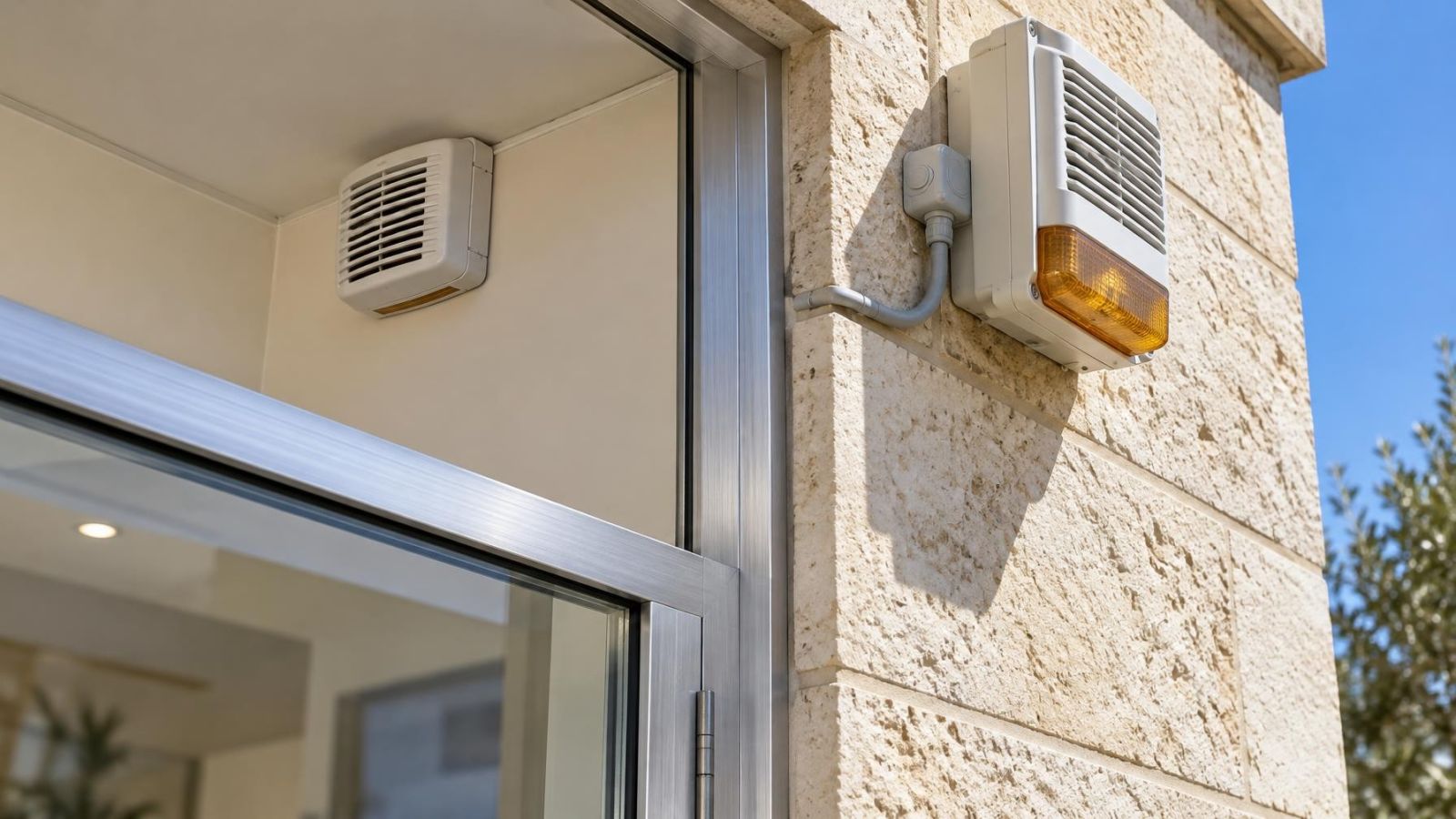
An outdoor siren provides indication beyond the protected interior. Its sound may be heard near an entrance, gate, garden, shared approach or street frontage. Many outdoor units also include a strobe light, giving a visible indication when sound is difficult to locate or when background noise masks it.
The strobe and sounder are related but separate forms of indication. A visible signal can help identify which property is reporting an event, while the sound provides a broader local alert. The alarm control panel may activate the indoor sounder, external sounder and strobe for the same event, or handle them differently according to the system configuration.
The important distinction is functional: the indoor siren is primarily for occupants, while the outdoor siren communicates beyond the interior. Installing a louder unit in one location does not necessarily cover the other role.
Indoor and outdoor sirens complement each other; they are not direct substitutes placed on opposite sides of a wall.
Do You Need Both Sirens?
Not every property needs the same arrangement. The decision starts with layout, occupancy and the places where an alarm indication must be noticed. It should not start with a catalogue specification considered in isolation.
In a compact apartment, one well-positioned indoor siren may be clearly audible throughout the occupied rooms. An outdoor unit may still be useful where external indication is wanted, but the available mounting area may be part of a shared façade or entrance. In an apartment building, discuss shared areas and visible exterior equipment with the relevant building representatives before fixing a location.
A private home often has more separation. Bedrooms may be upstairs, a study may sit behind a heavy door, and a garden gate may be some distance from the building. One indoor siren near the entrance cannot be assumed to cover every occupied zone. The design may call for more than one internal sounder, an outdoor sounder, or both.
A street-front shop or office has a different pattern again. A business alarm siren may need to be heard in a rear workroom while the external indication remains visible from the frontage. Storage rooms, internal offices, shutters and closed fire-resistant or acoustic doors can divide a small commercial property into distinct sound zones.
- Consider where people are present during normal use, including bedrooms, workrooms and rear offices.
- Check whether floors, corridors or closed doors separate those occupied areas from the proposed indoor siren.
- Decide whether an external audible signal is wanted, a visible strobe is wanted, or both are wanted.
- Identify shared entrances, façades and passageways that affect the choice of an outdoor position.
- Account for times when the property is occupied differently, such as a closed shop with staff working in a rear room.
Where Should Each Siren Go?
How should alarm siren placement be planned?
Good placement balances four requirements: audibility, visibility, resistance to casual interference and access for maintenance. Maximising only one of them usually creates a poor installation. The highest possible position may be difficult to service. The most visible position may receive severe sun. The loudest indoor position may be intolerable for anyone standing beside it.
An indoor siren should be placed where sound can spread through the occupied area without being immediately blocked by a cupboard, deep recess or closed partition. It should not be mounted beside a desk, bed or regular seating position merely because a cable route is convenient. The purpose is clear coverage, not unnecessary discomfort at close range.
In a larger property, think in audibility zones. A living area and nearby bedrooms may form one zone. A lower floor, detached workroom or rear stock area may form another. A mamad deserves specific attention because its heavy door and dense construction can reduce the clarity of sound coming from elsewhere. Test with doors in the positions used during normal occupancy.
The outdoor unit needs a clear sound path and, where fitted, a useful line of sight to the strobe. A location facing a garden, gate or street approach may be more useful than one hidden on a side wall. At the same time, avoid positions that are easy to reach from the ground or from a convenient ledge.
High mounting generally improves visibility and makes interference less convenient, but the unit must remain serviceable with suitable access. Batteries, terminals and enclosure seals eventually need inspection. A position that requires dismantling unrelated building elements whenever the unit is checked is not a sensible maintenance position.
Distance from the control panel also matters. For a wired siren, distance affects the cable route and the opportunity for physical damage along that route. For a wireless siren, building materials and intermediate spaces affect the radio path. The shortest straight-line distance on a drawing may not represent the best real connection.
Plan for Israeli Outdoor Conditions
An outdoor siren in Israel may spend long periods in strong sunlight even if rain exposure is limited. Heat around a sun-facing wall, ultraviolet exposure and glare on the strobe lens all belong in the location decision. A shaded position beneath an architectural projection can be preferable to a fully exposed wall, provided the sound and light are not obstructed.
Near the coast, humidity and salt-laden air make enclosure condition and cable entry details particularly important. Elsewhere, dust may be the more obvious issue, especially beside unpaved gardens, gates, loading areas and busy street fronts. Dust can gather around joints, openings and strobe lenses, so the installation should allow inspection and cleaning.
Choose an outdoor unit with an enclosure intended for the expected sun, dust and moisture exposure. Weather resistance is a property of the whole installation, not only the product casing. Cable entries, fixings, wall penetrations and the orientation of the enclosure all affect how well the assembly tolerates outdoor conditions.
- Prefer shelter from direct weather where it does not compromise sound or strobe visibility.
- Avoid creating an upward-facing cable entry or an unsealed path into the wall.
- Check whether irrigation spray, roof runoff or air-conditioning discharge reaches the proposed position.
- Allow enough space to open the enclosure without removing nearby signs, lighting or shutters.
- Include the strobe lens and enclosure seals in routine visual checks.
Choose the Connection and Backup
Wired and wireless sirens can both be appropriate. The better choice is the one that has a dependable path to the control panel, a defined response to loss of mains power and practical maintenance access. Connection type should be chosen before mounting positions are finalised.
A wired siren uses a physical cable route between the alarm equipment and the sounder. This can be straightforward during construction or renovation, when concealed routes are available. In a finished apartment or shop, the same route may require visible containment, careful use of existing service paths or a different siren position. The cable should not be run simply wherever it is easiest if that leaves it exposed to routine damage.
A wireless siren avoids a continuous signal cable, but it still needs a reliable radio path and a power plan. Reinforced walls, utility cupboards, metal shutters and separation between floors can weaken communication. A mamad can be especially relevant to radio planning. Signal behaviour should be checked at the intended final location, with doors and shutters in their normal positions.
| Planning point | Wired siren | Wireless siren |
|---|---|---|
| Connection path | Uses a cable route to the control panel or associated alarm equipment | Uses a supervised radio path to compatible alarm equipment |
| Power loss | Depends on the system power design and any local backup arrangement | Depends on its battery arrangement and the system response to low power |
| Installation impact | May require concealed cable, surface containment or building work | May reduce cabling but requires a suitable radio position |
| Maintenance focus | Cable condition, terminals, backup supply and enclosure | Battery condition, radio supervision, enclosure and signal path |
| Best considered | Before walls, ceilings and routes are closed | At the exact mounting point under normal building conditions |
Some external sirens have a local backup battery so they can continue to behave as designed during a power interruption or cable event. The installer should establish what the control panel supervises, what indication appears when power is low or communication is lost, and how the siren behaves during that condition. Backup is not complete merely because a battery is physically present.
Tamper detection is another part of the connection plan. Depending on the equipment, the system may monitor opening of the enclosure, removal from the wall or interruption of a circuit. The relevant question is not only whether a tamper feature exists, but whether it is connected, configured and tested through the control panel.
Maintenance access should remain possible without placing the siren in an exposed position. Battery replacement, enclosure inspection and functional testing need a safe, repeatable access method. If access depends on moving stock, crossing a fragile roof section or hiring unusual equipment, routine checks are more likely to become inconvenient.
Set the Installation Brief
A useful installation brief describes required behaviour rather than asking only for an indoor or outdoor product. It gives the installer enough information to plan sound coverage, external indication, connection and future access as one system.
- Mark the occupied areas where the indoor alarm indication must be clearly audible, including separated floors, rear rooms and the mamad.
- State whether the outdoor requirement is audible indication, visible strobe indication or both, and identify the approaches from which it should be noticed.
- Agree provisional siren and strobe locations after checking sound paths, sight lines, direct sun, dust, moisture and access from the ground.
- Record any limits on drilling, visible cabling, shared-building areas or radio paths through dense construction.
- Define how wired circuits or wireless supervision will report faults, low power, communication loss and tamper events at the control panel.
- Agree how each siren, the strobe and backup arrangements will be functionally tested after installation and during maintenance.
The final test should reflect the property as it is actually used. Close the doors that are normally closed. Lower shutters that are normally lowered. Check the rear office, bedrooms and mamad rather than listening only beside the control panel. For the outdoor unit, confirm that the sound path and strobe view match the agreed approaches without assuming that maximum exposure is automatically best.
A well-planned system gives each device a defined role. The indoor siren informs occupants. The outdoor siren and strobe provide indication beyond the protected interior. The control panel coordinates their behaviour, while the installation position, connection method and maintenance plan determine whether that behaviour remains clear and manageable.
Key takeaways
- An indoor siren serves occupants, while an outdoor siren provides audible and sometimes visible indication beyond the protected interior.
- Siren placement matters as much as siren type because walls, closed doors and separated spaces change how sound travels.
- Strong Israeli sunlight, dust and coastal humidity should be considered when choosing and positioning an outdoor siren.
- Connection method, backup power, tamper detection and maintenance access should be decided before either siren is mounted.