On this page
A magnetic contact on a sliding balcony door is not installed in quite the same way as one on an aluminium window frame or a roller shutter. The opening moves differently, and the nearby tracks, handles and screens create different constraints. An alarm installer therefore starts with the opening itself, not the sensor. This guide explains how magnetic contact placement should be planned, mounted and tested for the sliding openings commonly found in Israeli homes and small businesses.
The basic principle is simple. A magnetic contact reports whether its sensor and magnet are within their operating gap. It does not understand whether a door is secure, a shutter is fully lowered or a window is slightly open. It only reports the relationship between its two parts. Reliable installation depends on making that relationship match the movement you want the alarm system to report.
Map the Opening Before Magnetic Contact Placement
Before choosing a mounting point, identify every part that can move. A typical sliding balcony door may have two glass panels, an insect screen and an external roller shutter. A sliding window may have several overlapping aluminium panels. Some panels move independently; others are normally left in place but can still be opened.
Next, decide which opening routes need to be reported. If either of two panels can create an opening, monitoring only the panel used every day leaves the other movement outside the detection plan. The same applies to a screen or shutter: it may affect access and mounting space, but it does not replace monitoring of the glazed opening unless that is the intended system design.
The required ventilation position also matters. Some occupants want to arm the system while a sliding window remains slightly open. A conventional contact normally reports that position as open because the magnet has moved away from the sensor. A second magnet or a different detection arrangement may support a defined ventilation position, but it must be planned deliberately. The alarm user should understand which positions report closed and which report open.
In Israel, shutters and insect screens are often closely integrated with the window or balcony-door assembly. They can hide the top of a frame, cross a proposed cable route or pass very close to a surface-mounted contact. Open and close every layer before settling on a location.
Where Should the Contact Go?
Where should a magnetic contact be placed on a sliding door?
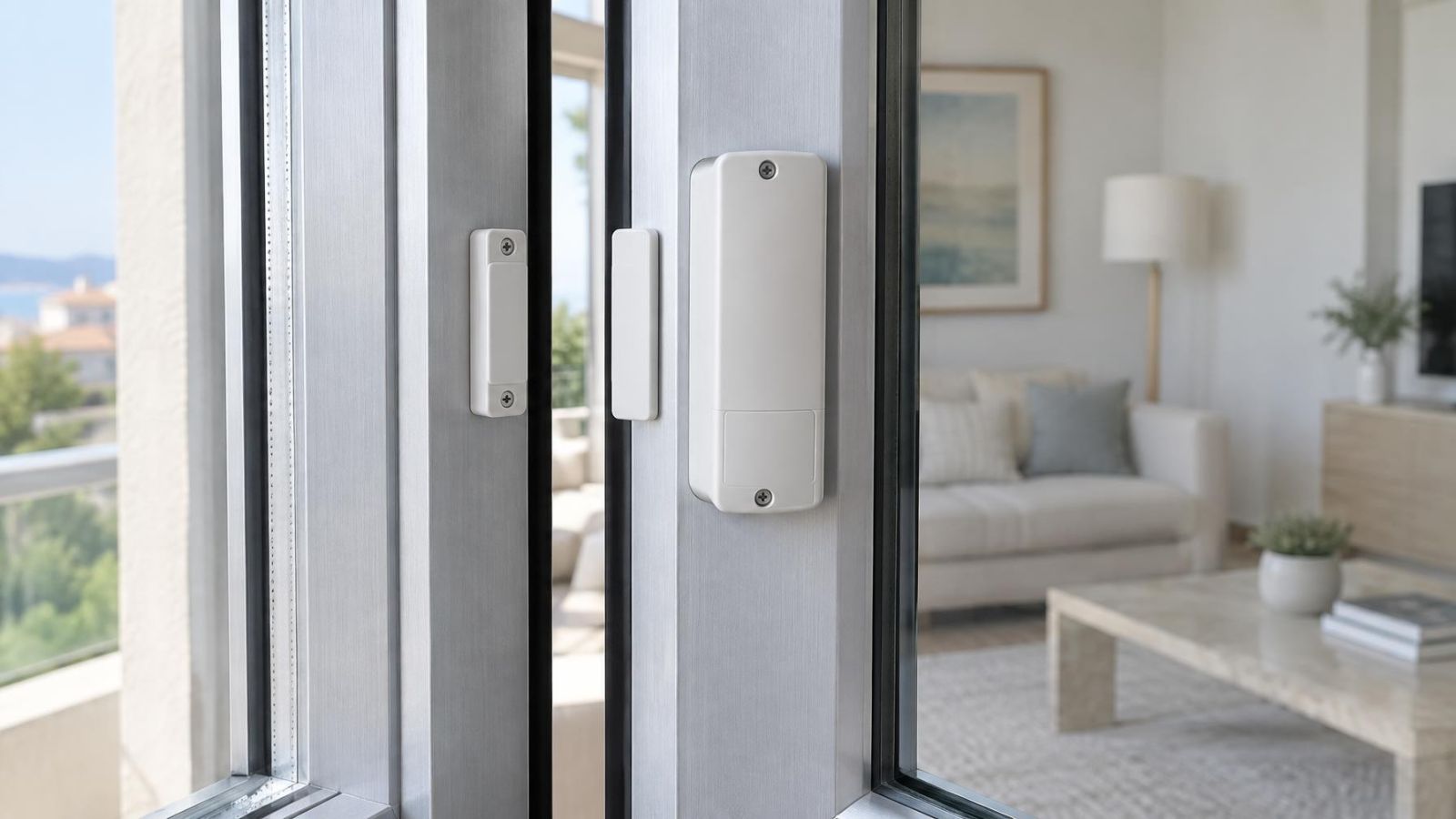
Place the sensor on a fixed frame and the magnet on the sliding panel, or use another pair of surfaces that move relative to one another. The two parts should align when the door is fully closed and separate reliably as the panel begins to open. The fixed-frame position usually makes wiring easier and keeps the more sensitive component away from repeated movement.
There is no universal top, side or bottom position. The best location is the one that provides stable alignment without interfering with the track, handle, lock, drainage path, cleaning access or insect screen. Top mounting often keeps the parts away from hands and floor dirt, but a deep frame profile or shutter housing may make side mounting more practical.
A sliding door alarm sensor should not act as a mechanical stop. Leave enough clearance for normal panel flex and small changes in movement. The magnet must pass the sensor without striking it, including when the door is moved firmly from its usual handle. A position that works only when the panel is guided carefully is not a finished installation.
How do you install an opening sensor on a sliding window?
Start by closing the window in its normal latched position. Temporarily position the window contact sensor on the fixed frame and its magnet on the moving sash. Confirm that the pair aligns without entering the track or obstructing the handle. Then slide the sash through its full travel and check the screen, shutter and adjacent panel before drilling, bonding or routing cable.
Do not treat the latch position as the only possible closed position. Some sliding windows have play within the frame, particularly when they are pushed from different edges. Test the contact while closing the window using the handle as occupants normally do. The system should report consistently despite ordinary movement within the frame.
Plan for Multiple Sliding Panels
Does each sliding panel need its own sensor?
Each independently moving panel needs an explicit detection decision if every opening route must be monitored. This does not always mean identical hardware on every panel, but it does mean checking how each panel can move and what the alarm system should report.
A contact on one frequently used panel reports only that panel's relationship to its frame or neighbouring surface. It cannot report movement elsewhere unless the mounting arrangement is specifically designed around that movement. Assuming that one contact covers the whole window simply because all the panels share one outer frame is a common planning error.
Overlapping panels provide several possible mounting arrangements. A sensor may be fixed to the outer frame with a magnet on one sash, or the two parts may be placed across neighbouring panels when their relative movement is the event being monitored. The second approach requires particular care: moving either panel may change the contact state, and one panel may carry wiring or hardware through its travel.
For each panel, write down the expected result in plain language: panel A opens and reports open; panel B opens and reports open; the screen moves and has no effect; the shutter moves and is reported separately. This simple exercise exposes unmonitored movement before hardware is fixed.
An unmonitored panel should be a conscious system choice, not an accidental consequence of convenient mounting. Remote property owners should ask for the opening logic to be documented, because a mobile alert showing one zone name may not reveal which physical movements that zone actually covers.
Choose the Contact and Mounting Method
Contact selection follows the frame material, available space and route for maintenance. A reed switch and sensor magnet may work correctly on a workbench but behave differently when placed on a substantial aluminium profile. Metal can alter the useful magnetic relationship, so catalogue dimensions are not a substitute for testing on the actual opening.
Surface-mounted and recessed contacts solve different installation problems.
| Method | Advantages | Points to check |
|---|---|---|
| Surface-mounted contact | Visible alignment is easy to inspect and adjust | Clearance from screens, shutters, handles and cleaning tools |
| Recessed contact | Hardware can be less visible and less exposed | Suitable cavities, accurate drilling, frame depth and future access |
A recessed contact is not automatically the better finish. Aluminium frames may have internal chambers, reinforcement or moving components that make drilling unsuitable. Once inserted, the contact can also be harder to adjust. A neat surface-mounted installation with the correct spacers is often more serviceable than a recessed installation placed for appearance alone.
The wired-versus-wireless decision is mainly about access. A wired sensor needs a protected cable route back to the alarm equipment. The cable should not cross a sliding track, fold at a moving joint or remain exposed where routine cleaning can catch it. Existing construction may provide a concealed route; completed frames and tiled surrounds may not.
A wireless sensor avoids the long cable route but needs physical room and future battery access. It should be possible to open its cover without removing a shutter guide, dismantling a screen or forcing the sliding panel off its normal path. The enclosure must also stay clear of moving hardware.
Which Sensor Suits a Roller Shutter?
Which alarm sensor works with a roller shutter?
A roller shutter alarm sensor should be designed or configured for the movement, vibration and mounting conditions of the shutter. A standard contact intended for a lightly moving window sash may not suit a bottom bar that shifts, rattles or stops with small variations in position.
One common arrangement monitors the relationship between the shutter's bottom bar and a fixed point near the sill or guide area. Another uses shutter-suitable hardware positioned around the guide. In either case, the moving component must approach the fixed component consistently when the shutter reaches the intended closed position.
Allow for lateral movement and vibration. The bottom bar may not settle at precisely the same angle every time, and a motorised shutter may stop differently from a shutter lowered by hand. The operating gap needs enough tolerance for normal closure, but not so much that meaningful upward movement continues to report closed.
Manual and motorised shutters should be tested according to how they are actually operated. For a manual shutter, lower and raise it using the normal strap, crank or handle. For a motorised shutter, operate it from its usual control and observe the final resting position. Do not pull or guide the shutter into an unusually neat position just to make the contact align.
A shutter contact reports the selected shutter position; it does not report the state of the window behind it unless the system also monitors that window. If both movements matter, treat them as separate detection decisions and label the zones clearly.
Test Before Final Fixing
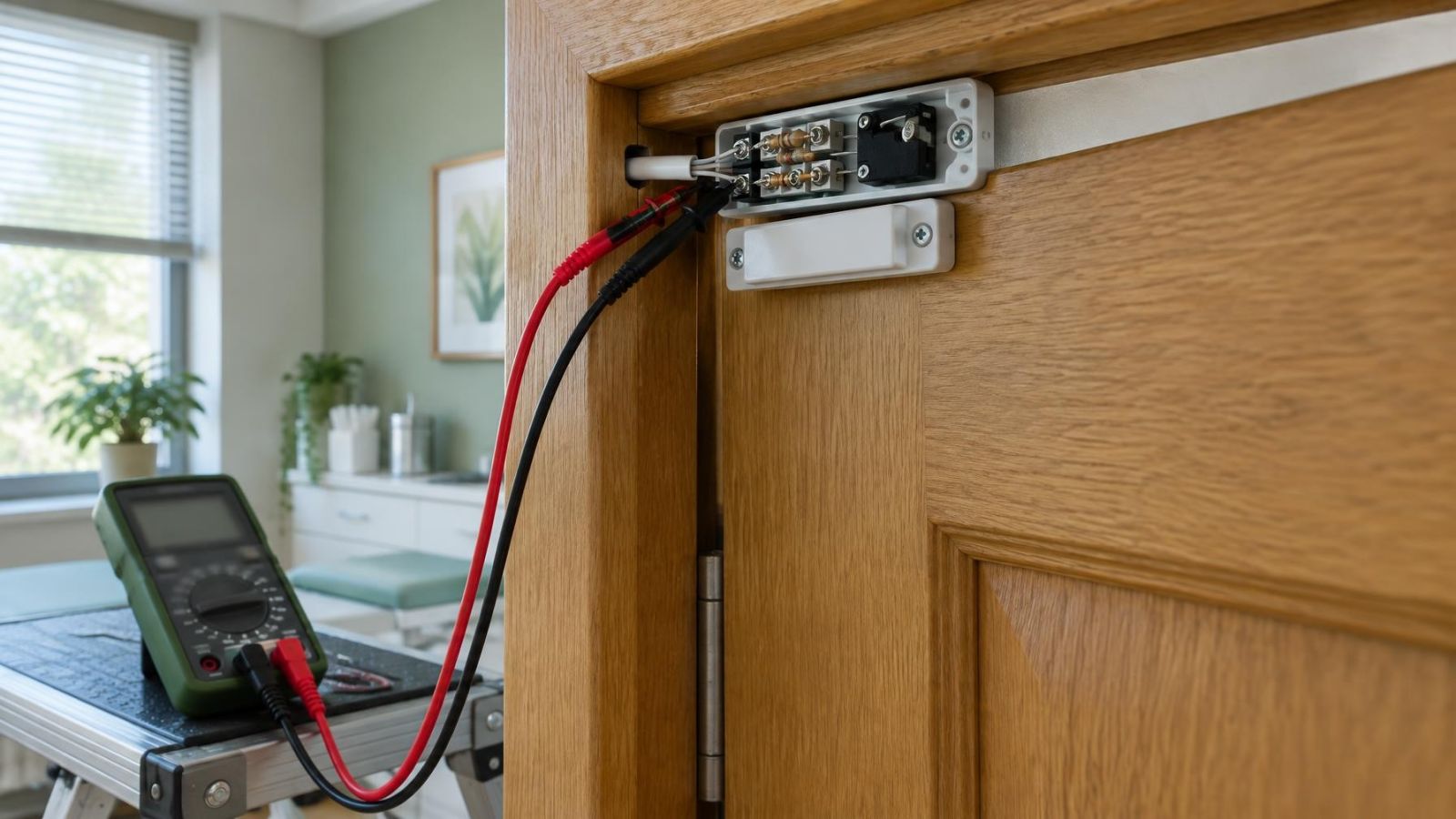
Temporary positioning is the safest way to confirm the design. Hold or lightly secure the sensor and magnet where they can be moved without damaging the frame. Connect them to the intended alarm input, or use the appropriate test indication, and verify the reported state rather than relying only on visual alignment.
Testing should follow a repeatable sequence:
- Close the opening normally and confirm that the system reports the intended closed state.
- Open the panel slowly and confirm that the state changes as the sensor and magnet separate.
- Move the panel through its full travel while watching for contact with tracks, handles, screens, shutters and neighbouring panels.
- Repeat the operation several times from the normal handle, without supporting or guiding the panel near the sensor.
- Operate every independent panel and every defined ventilation position, checking each expected report.
- Confirm that covers, batteries, cable connections and fixing points remain accessible after nearby components are returned to place.
A full-travel check often changes the preferred mounting point. A magnet that aligns perfectly when closed may strike an overlapping sash halfway through travel. A cable that appears protected may become exposed when an insect screen is removed. A wireless cover may be accessible until the roller-shutter guide is refitted.
Final fixing should come only after the opening has passed the operating test. Record which panel is monitored, what position reports closed and whether a shutter or ventilation setting has separate logic. Clear zone naming is especially useful for a business owner or remote property owner who may need to interpret an alert without standing beside the opening.
The correct final choice can differ from one opening to the next, even within the same room. Frame depth, panel overlap, shutter guides and available cable routes all change the practical answer. Consistency is useful, but reliable movement and maintainable access matter more than making every contact look identical.
A contact is reliable only when its reported state follows the real movement of the opening, not merely when its parts line up once.
Key takeaways
- Sensor placement must follow the actual movement between a fixed surface and the part that opens.
- Every independently moving panel needs an explicit detection decision if all opening routes must be reported.
- Aluminium frames, tracks, handles and insect screens must be tested with the contact in its intended position.
- Roller shutters require contacts selected and positioned for shutter movement, vibration and normal stopping behaviour.
- Permanent fixing should follow a full operating test of every monitored panel and shutter position.