On this page
A mamad door sensor brings several constraints together: a magnetic contact, a metal door frame, a reinforced concrete wall and a door that must move and close without obstruction. The choice between a wired alarm sensor and a wireless alarm sensor cannot be made from the room plan alone. The question is where the contact can operate consistently, remain accessible and communicate correctly without affecting the mamad door.
Why Mamad Construction Changes the Plan
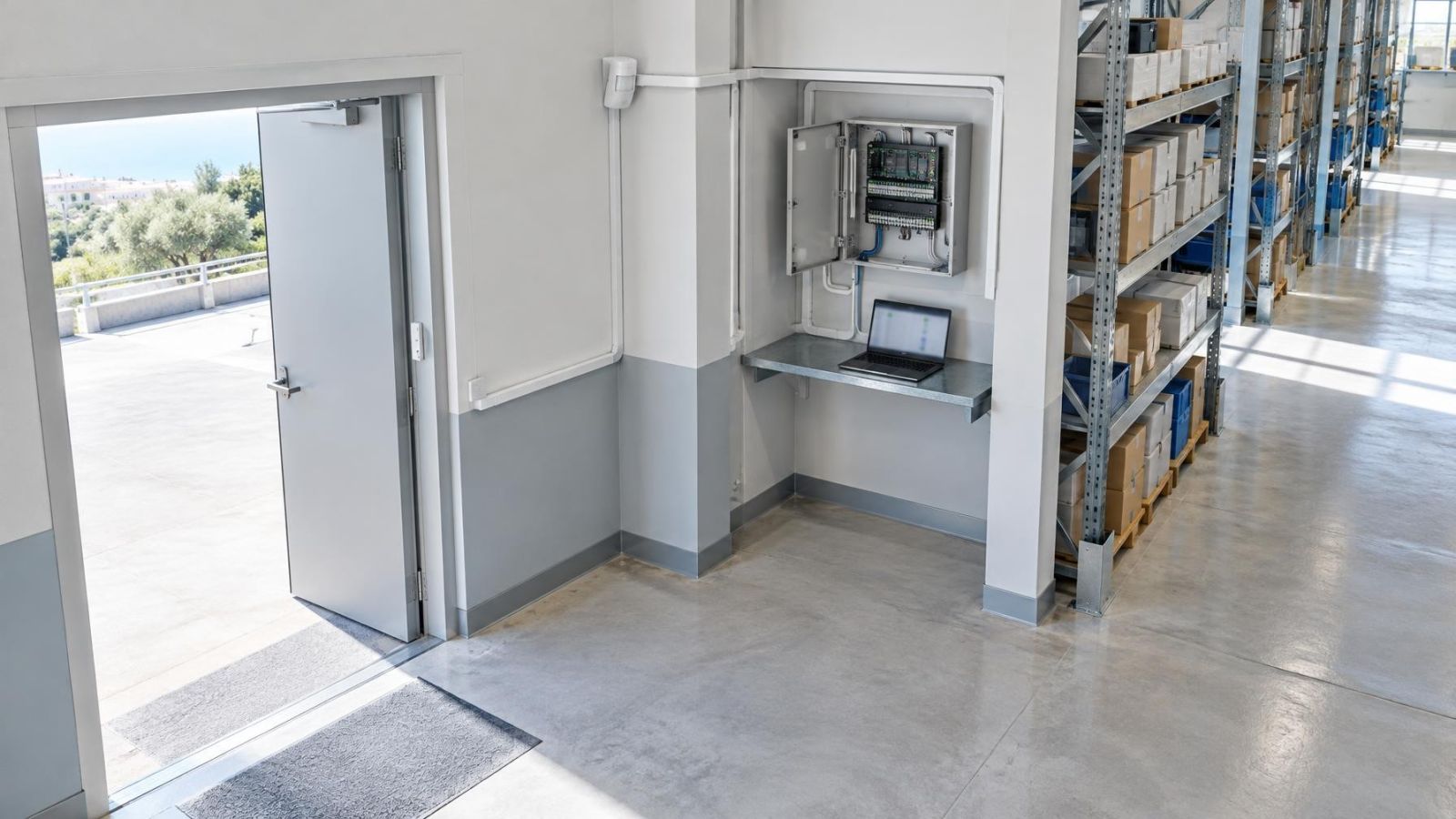
A mamad is the reinforced room commonly included in Israeli homes and apartments. Its walls and door assembly are unlike a normal internal room. Reinforced concrete can weaken or redirect radio communication. The metal door and frame can also reflect radio energy, creating a signal path that is less predictable than the physical distance to the alarm panel suggests.
The metalwork matters to the magnetic contact as well. A contact detects the relationship between its sensor and magnet when the door is closed. Nearby metal can alter that relationship, so a position that looks correctly aligned may not provide a dependable operating gap. The result has to be checked on the actual door rather than assumed from a drawing or from performance on a timber frame.
Door movement adds another constraint. The contact and magnet need enough clearance through the entire swing, including any slight change in the leaf position as the handle and locking mechanism engage. Nothing should press into the rubber seal, project into the threshold area or sit where the door can strike it.
- Treat the reinforced wall, metal frame and metal door as parts of one installation environment.
- Check the proposed location with the door resting closed and with its locking hardware fully engaged.
- Allow for the complete opening path, not only the final open and closed positions.
- Keep the component accessible for testing, cleaning and eventual replacement.
Where Should the Mamad Door Sensor Go?
What matters when planning an alarm sensor for a mamad?
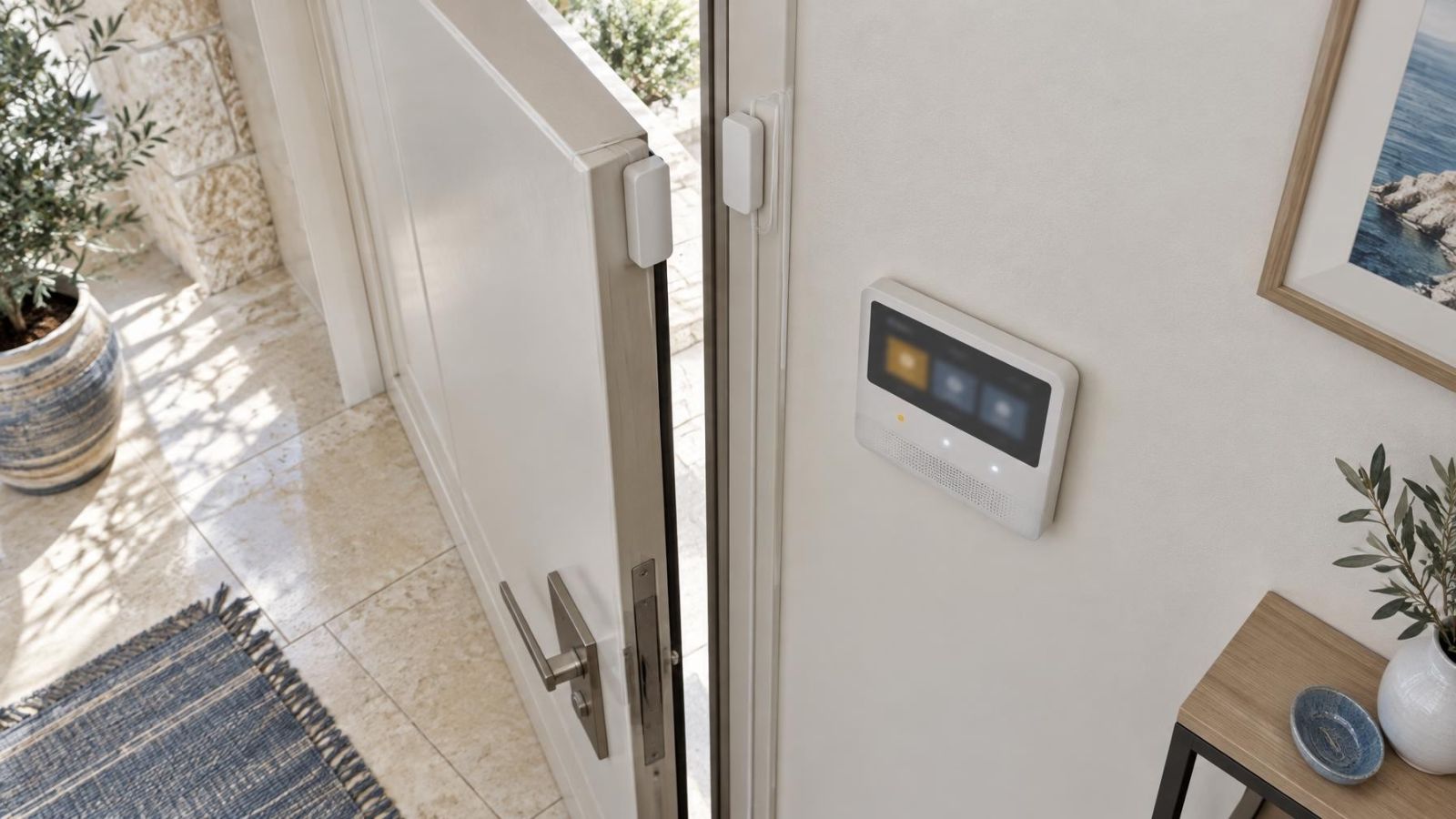
The best position is a stable area where the two parts remain consistently aligned whenever the door is closed. One part is fixed to the frame and the other follows the moving leaf. The exact arrangement depends on the contact design, but the fixed component should normally be placed where it can be serviced without disturbing the door or its seals.
Visual symmetry is not the priority. A neat central position may conflict with the handle, locking rods or frame geometry. A very discreet location may be difficult to test. A position close to the hinges may also allow the door to open some distance before the contact and magnet separate enough to register the change. Moving towards the latch side can produce earlier separation, but only if the lock and handle remain clear.
Alignment must be assessed in three dimensions. The faces of the sensor and magnet may need to be level, but their side-to-side relationship is equally important. A stepped frame can leave one component farther forward than the other. An appropriate spacer may correct the geometry, provided it remains secure and does not bring the component into the path of the door.
- Choose a rigid section of the frame rather than a trim piece that can move or flex.
- Match the sensor and magnet positions with the door fully closed.
- Keep both parts away from hinges, handles, locking hardware and impact points.
- Confirm that the location can be reached later without removing door components.
- Use a position where the indicator, test control or cover can be accessed if the device has one.
Choosing Wired or Wireless Detection
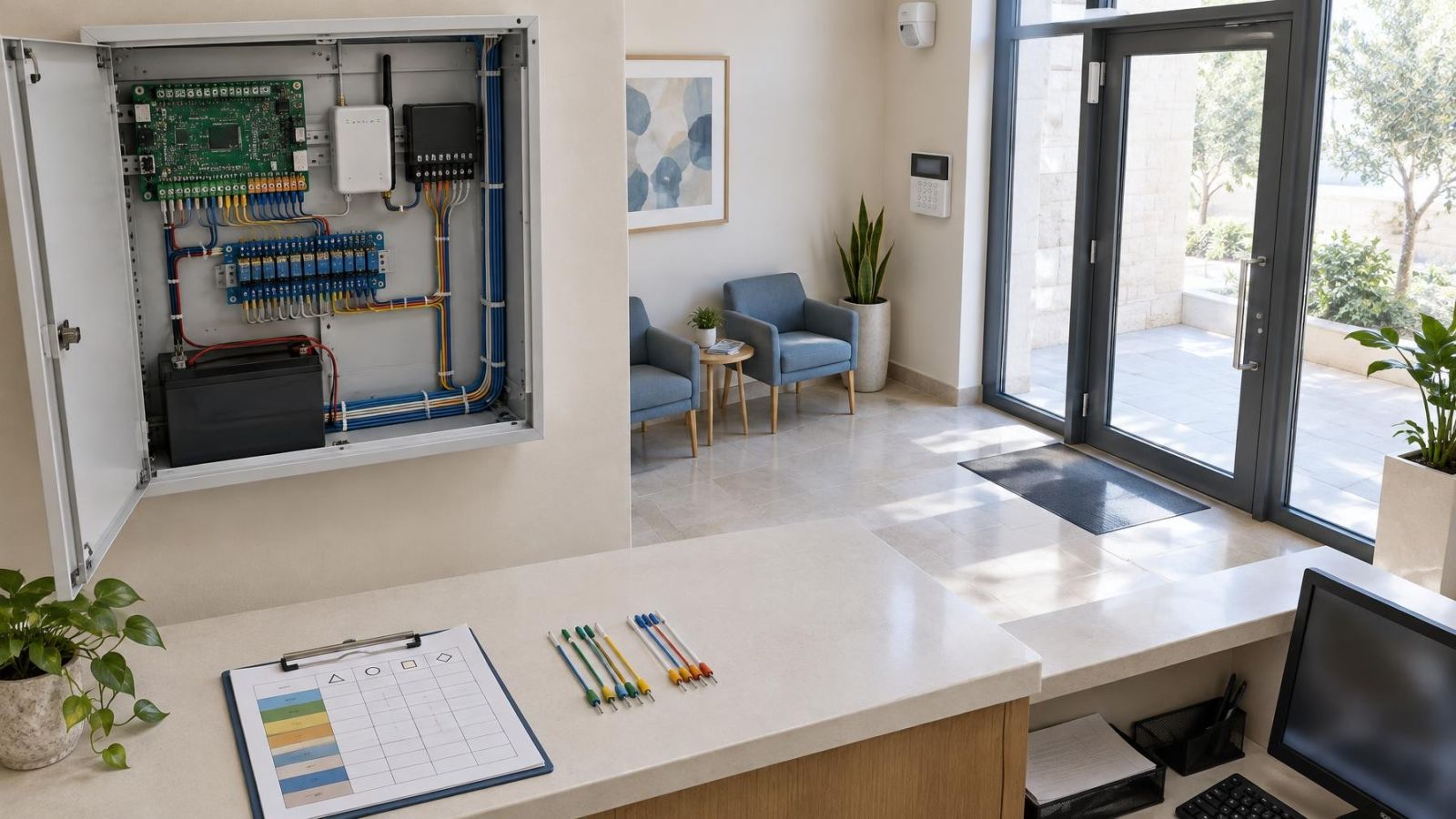
A wired contact provides a physical communication path back to the alarm equipment. It avoids dependence on radio propagation around reinforced walls, but it needs a protected cable route from the door area to the control panel or an appropriate wired connection point. The route should not leave a loose cable beside the frame or require a cable to cross a moving joint without suitable protection.
Wireless detection reduces the need for a continuous cable route, which can be useful in a finished home. It does not remove the need for planning. The wireless sensor must communicate through the complete building layout, and it needs to remain accessible for testing and power-source replacement. A short straight-line distance to the panel does not prove that the radio path is good.
| Planning factor | Wired detection | Wireless detection |
|---|---|---|
| Communication path | Uses a physical cable connection | Uses a radio path through and around the building |
| Preparation | Benefits from a planned conduit or protected route | Benefits from testing at the intended mounting point |
| Maintenance access | Requires access to terminals and cable ends | Requires access to the device and its power source |
| Effect of reinforced construction | Concrete and metal mainly affect cable routing | Concrete and metal can weaken or redirect communication |
| Best planning stage | Before wall and ceiling finishes are complete | At any stage, provided the final position can be tested |
During renovation, it is sensible to prepare a cable route even when wireless detection is being considered. Conduit or another protected path preserves options without requiring the sensor choice to be final at the same moment as the building work. In an already finished apartment, the decision often turns on whether a discreet, protected route exists and whether wireless communication passes an on-site test.
Will a Wireless Alarm Work Around a Mamad?
It can work, but the answer depends on the complete radio path. Reinforced walls, the metal door, nearby structural elements and the location of the alarm receiver all influence communication. Signal strength cannot be judged reliably by counting walls or measuring only the straight-line distance.
How should the alarm signal around a safe room be tested?
Place the wireless device at the intended mounting point and run a connection test using the actual alarm equipment. Check it first with the mamad door open and then with the door fully closed. The closed-door result is essential because the metal leaf may change the path between the device and receiver.
Testing should also reflect normal conditions around the room. Stand clear of the doorway rather than holding the device in a hand or leaving an installer between the sensor and the wall. If communication is marginal or inconsistent, moving the sensor, panel or compatible receiver may improve the path. Where relocation does not give a stable result, use the prepared wired route rather than treating an occasional successful message as sufficient.
Mounting on the Metal Door
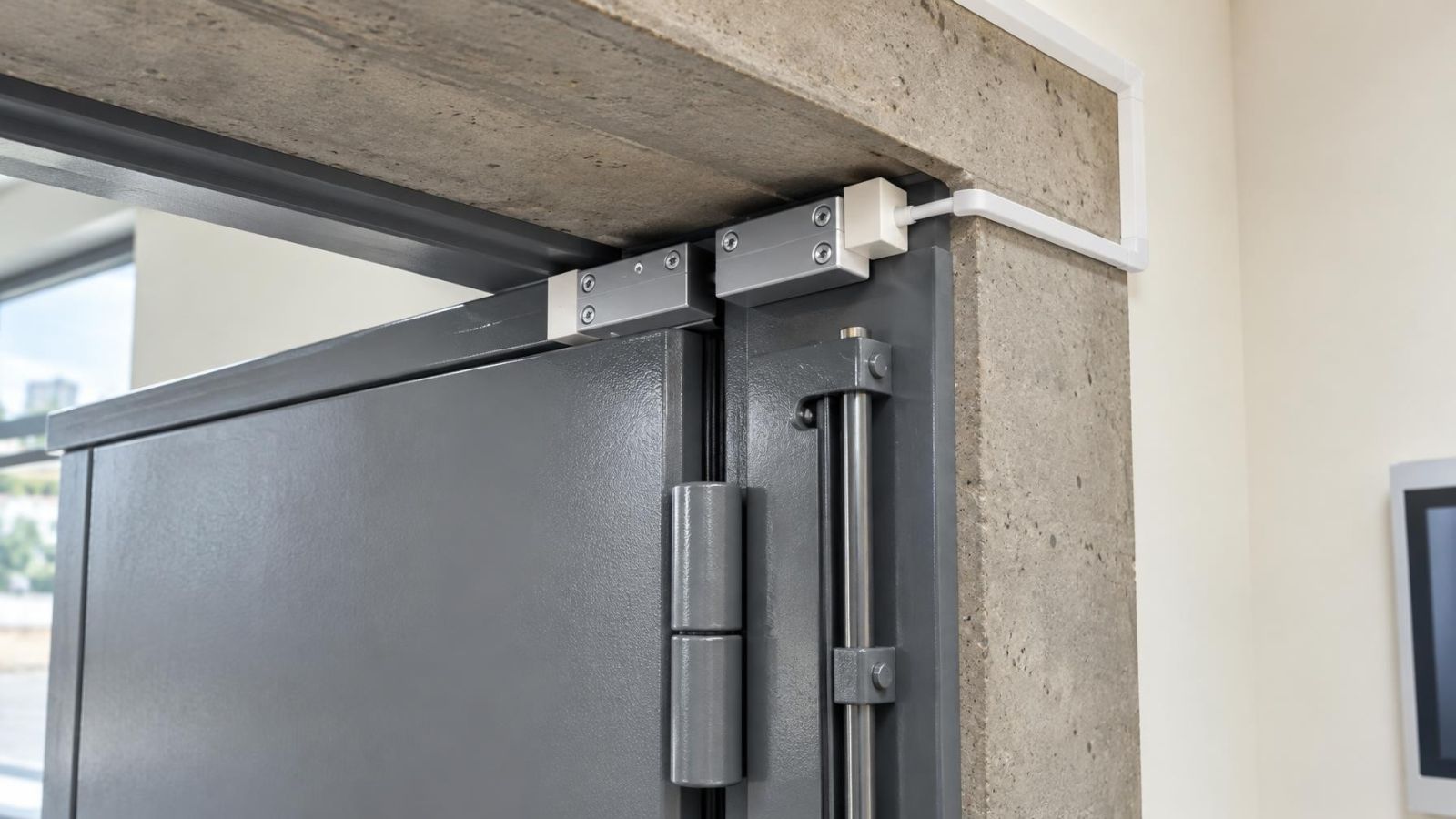
Use a contact intended for surface mounting when the door construction does not provide a suitable recessed location. Surface components make alignment visible and usually simplify later access. They still need a fixing method suited to the metal surface, the component housing and the movement of the door.
The mounting surface should be clean, stable and flat enough to prevent the housing from rocking. Adhesive fixing can shift if the surface is dusty, warm or uneven. A mechanical fixing may be more stable in some locations, but drilling should never be treated as automatic. The proposed point must be examined so the fixing does not interfere with the door assembly, hidden mechanisms or normal operation.
Metal near the contact can change its effective operating gap. Test the contact directly on the intended surface, with any spacer or mounting plate that will remain in the finished installation. Do not test it in free air and assume the result will be identical after it is attached to the door.
Protection from knocks matters too. A contact projecting into the opening can be hit by furniture, bags or routine movement through the doorway. Repeated vibration can also loosen a poorly supported part. A compact position against a stable face is preferable, provided the cover can still be removed and the magnet remains correctly aligned.
Avoiding Door and Seal Interference
A safe room alarm sensor is secondary to the proper movement of the door. The sensor, magnet, cable and fixings must remain outside the working areas of the rubber seal, threshold, hinges, handle and locking mechanism. The door should close and lock with the same movement and pressure as it did before the installation.
Pay particular attention to stepped frame edges. A component can appear clear while the door is open yet compress a seal or touch the leaf during the final part of closing. The threshold is another poor location for exposed parts because it receives foot traffic, cleaning water and impacts.
For a wired installation, keep the cable on the fixed side wherever practical. If a cable must pass between fixed and moving sections, it needs a transition designed for repeated movement and protection against pinching and abrasion. A loose loop across the hinge area is not a durable cable route.
- Close the door slowly while observing every part of the contact and cable.
- Operate the handle and locking mechanism through their full travel.
- Inspect the rubber seal for pressure marks or displacement.
- Check clearance above the threshold and along the frame.
- Confirm that no cover, screw head or cable edge can catch during movement.
Test Before Final Fixing
Temporary placement is the point where the installation moves from theory to evidence. Hold or tape the components in the intended positions without allowing the tape itself to alter the gap. Then test the contact repeatedly before making holes or applying a permanent fixing.
- Position the sensor and magnet temporarily at the proposed mounting points.
- Close the door normally and confirm that the system reports the contact as closed.
- Open the door repeatedly and confirm that each opening is detected at a useful point in the movement.
- For a wireless device, run communication checks with the door open and fully closed.
- Confirm that fault and tamper indications operate if those functions are provided.
- Lock and unlock the door, inspect all clearances and then select the final fixing position.
Repeated testing is important because a single successful operation can hide marginal alignment. Close the door gently, close it firmly and operate the lock as it is normally used. The contact should report the same state each time without depending on someone pushing the leaf towards the frame.
Remote status is useful for a property owner who is not always on site, but it does not replace physical testing. Someone still needs to confirm that the magnet has not shifted, the housing is secure, the cable is protected and the door remains unobstructed. Final fixing should happen only after both mechanical operation and alarm communication have been checked in the finished position.
Key takeaways
- Mamad construction makes the sensor position and the complete communication path part of the same planning decision.
- A stable and accessible mounting point is more valuable than a discreet position that allows movement or poor alignment.
- Wireless communication around a mamad must be tested with the door closed, not inferred from distance alone.
- A protected wired route is easiest to prepare before walls, ceilings and decorative finishes are complete.
- Door contacts must remain clear of seals, thresholds, handles, locking hardware and the full travel of the door.