On this page
A shock sensor, a magnetic contact and an alarm system do not all describe the same event. On a sliding window, glass door or aluminium frame, the choice of shock sensor versus contact decides whether the system responds to movement of the opening, vibration through the surface, or both. This guide settles which detector fits each opening in an Israeli home or small business, and when combining them is justified.
Shock Sensor Versus Contact: What Each Sensor Detects
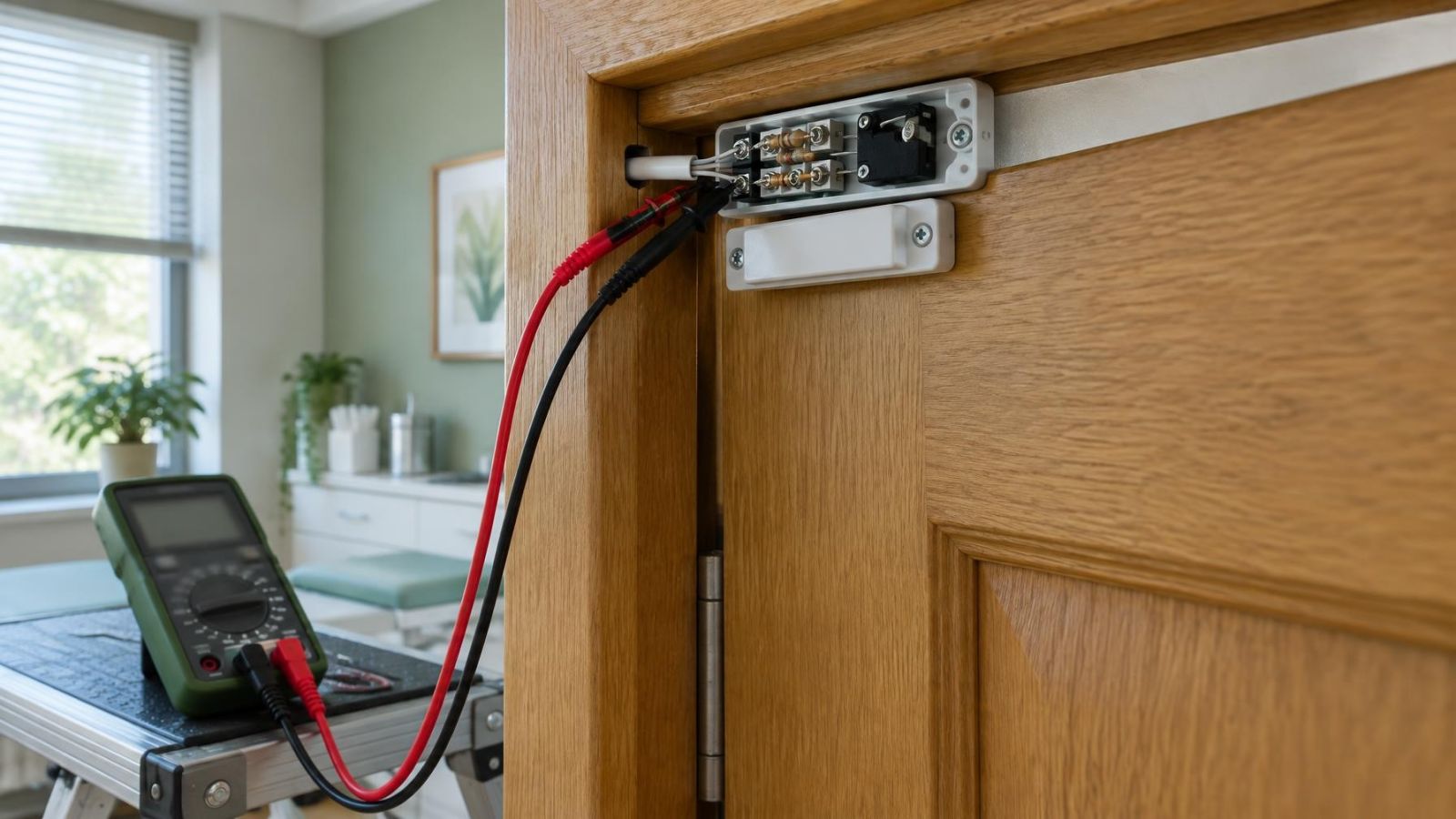
A magnetic contact has two aligned parts. One sits on the fixed frame and the other on the moving door or window. When the opening moves far enough for the two parts to separate, the contact changes state. The alarm panel can then treat the opening as open.
A shock sensor works through mechanical movement. It responds when impact or vibration travels through the glass, frame, door leaf or other surface carrying the detector. It can therefore react while the opening remains fully closed. It does not, by itself, confirm whether the door or window is open.
| Detector | Event detected | What it does not establish | Main installation concern |
|---|---|---|---|
| Magnetic contact | Separation of the moving part from the frame | Impact against a closed opening | Accurate and stable alignment |
| Shock sensor | Vibration or impact through the mounted surface | Open-or-closed position | Rigid mounting and suitable sensitivity |
How does a door contact alarm work?
The important point is not physical contact between the two pieces. A small operating gap is normal. What matters is whether the magnet and contact remain within their intended relationship when the door is closed, and separate clearly when it opens. A loose frame, moving bracket or badly positioned magnet can make the reported state unreliable.
These detectors are therefore not interchangeable labels for the same protection. One reports movement of the opening. The other reports energy passing through a surface. Choosing between them starts with deciding which event the alarm system needs to recognise.
Where Contacts Work Best
Contacts are the natural choice where the useful event is straightforward: a closed door or window becomes open. A hinged entrance door usually provides a clear fixed side, a predictable moving leaf and enough separation for a clean change of state. The same principle applies to balcony doors, service doors and accessible windows.
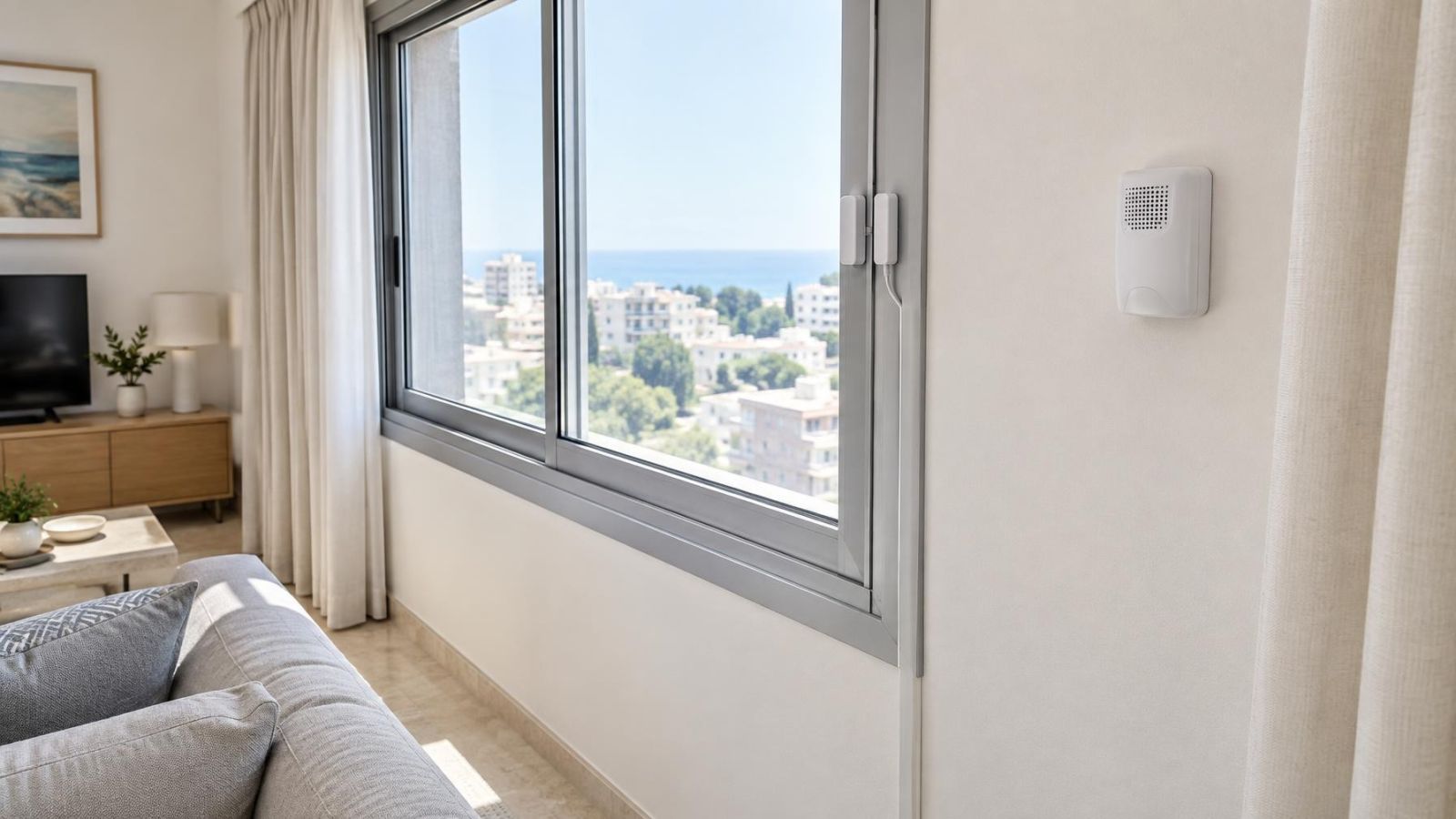
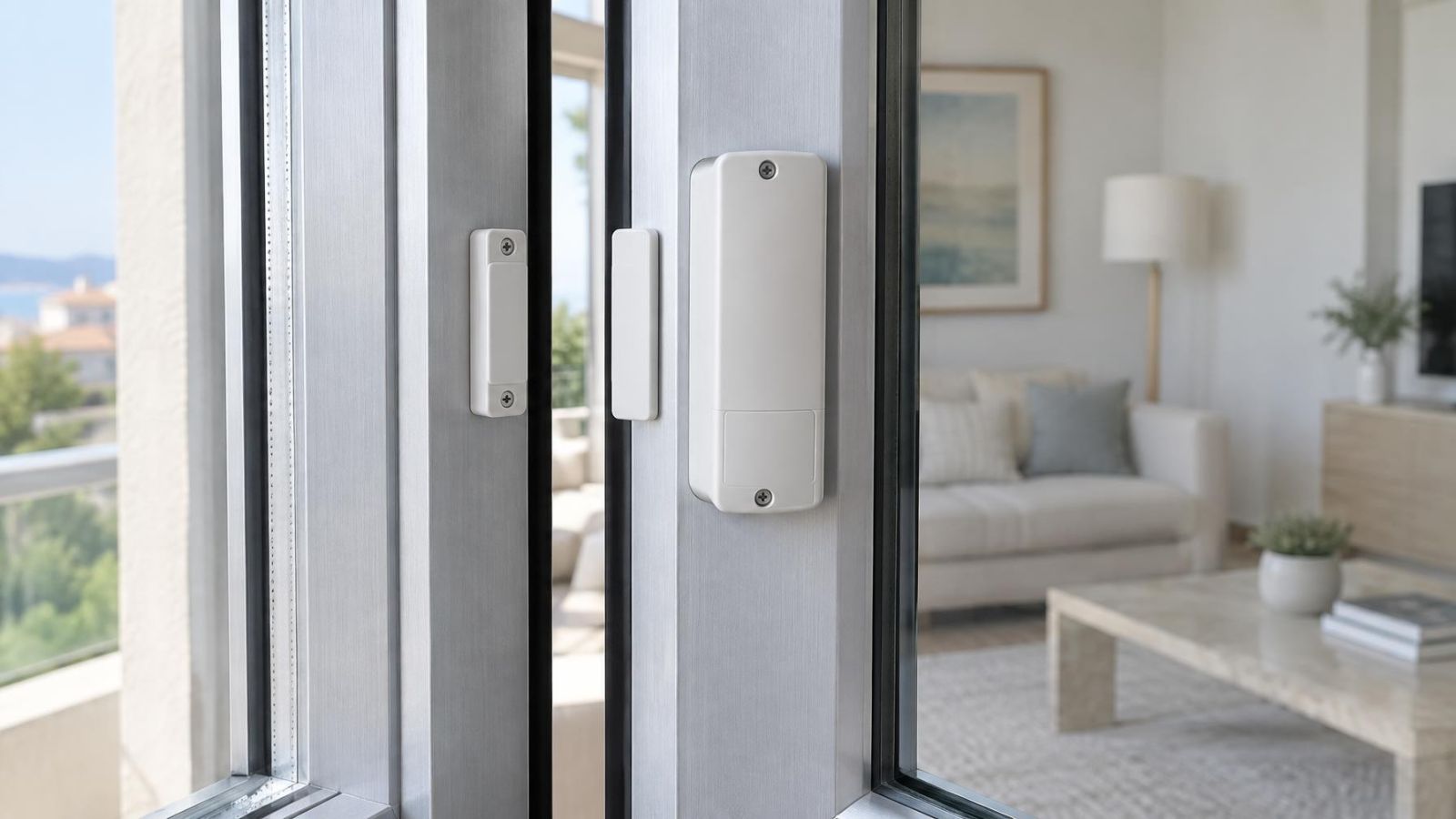
Sliding openings require more thought. Israeli apartments commonly have aluminium tracks with several moving glass panels. The detector must correspond to the panel actually used for entry. A contact placed across the wrong pair of panels may continue to show a closed state while another panel moves.
- Hinged doors: Keep both parts away from hinges, flexing trim and places where the frame shifts under closing force.
- Sliding windows and doors: Follow the active panel and confirm the contact changes state throughout the practical opening movement.
- Multiple panels: Decide whether one panel is fixed in normal use or whether several moving sections need independent treatment.
- Loose or uneven frames: Correct the mounting position rather than relying on a marginal magnetic gap.
A recessed contact sits within prepared holes in the door and frame. It gives a discreet finish and is less exposed to knocks, but it requires suitable material, sufficient depth and careful drilling. A surface contact is visible, yet it is often the more sensible option on narrow aluminium profiles, finished frames or openings where future access matters.
When Is a Shock Sensor Better?
A shock sensor is useful when the relevant event can occur before the opening separates from its frame. Impact on a glass panel, door leaf or frame sends vibration through the structure. A properly mounted detector can respond to that vibration while the opening remains closed.
This makes shock sensing worth considering for large glazed areas, glass doors and windows that are expected to remain shut while the alarm system is armed. It is not automatically better for every pane. The surface must transmit useful vibration to the detector, and the mounting point must provide a firm mechanical connection.
What causes a shock sensor alarm?
The detector responds to vibration patterns or impact levels allowed by its adjustment. The exact response depends on the detector, the rigidity of the surface and where it is mounted. A solid frame can carry impact clearly. A flexible panel, loose trim or soft mounting layer may absorb or distort the movement before it reaches the sensor.
Sensitivity must be tested on the actual opening. Set too low, the detector may not react to the intended test impact. Set too high, it may produce unwanted alarms from ordinary activity. Street-front shops may receive vibration from shutters, heavy doors, deliveries or traffic immediately outside. Homes can have movement from wind-loaded gates, slamming internal doors or loose window hardware.
Is a window vibration sensor suitable for every frame?
No. A window vibration sensor needs a mounting point that is rigid enough to transfer useful movement and stable enough to avoid unrelated vibration. Thin trim, decorative covers and loose glazing beads are poor mounting surfaces. The installer should test both the intended response and normal environmental movement before deciding that shock sensing is suitable.
Shock sensitivity is not a universal setting. It belongs to a particular detector, mounted in a particular place, on a particular structure.
Choosing for Israeli Openings
The opening itself should drive the decision. Israeli homes and small businesses often combine narrow aluminium profiles, several sliding panels, large areas of glass and external metalwork. Each behaves differently under movement and impact.
- Aluminium window profiles: Narrow sections may leave little flat mounting space. A compact surface contact can be easier to position than a recessed unit. A shock sensor needs firm attachment to a structural section rather than a loose cover.
- Multi-panel sliding windows: Identify which panels move and which overlap. The contact arrangement must report the panel used for access, not merely the outer frame.
- Glass doors and shopfronts: A contact clearly reports opening. Shock sensing can add a separate response to impact, provided vibration transfers well to the chosen mounting point.
- Garden gates: Wind, gate flex, imperfect latching and outdoor movement can disturb alignment or create vibration. A gate should not receive the same detector choice or sensitivity setting as a rigid indoor door.
- Shared apartment entrances: The entrance serves several households and may be used continuously. Detection choices should reflect normal traffic, door-closer movement and the way the building manages the shared alarm or access equipment.
Strong sunlight also changes installation practice. Hardware and adhesive mounting exposed through glass can experience sustained heat, while dust can collect around tracks and moving panels. Near the coast, humidity and airborne residue make exposed connections and poorly sealed mounting methods less attractive. These conditions do not dictate one detector type, but they affect where and how it should be installed.
On street frontage, separate structural vibration from meaningful impact. A shopfront beside a frequently used shutter or heavy neighbouring door may pass movement along the frame. Testing during normal business activity is more informative than testing only in a quiet, empty space.
Wired or Wireless Installation
Detector type and connection method are separate decisions. Both contacts and shock sensors may be available as wired or wireless devices, but the alarm panel must support the chosen detector and its method of reporting. Compatibility should be confirmed before holes are drilled or finished surfaces are disturbed.
| Installation issue | Wired sensor | Wireless sensor |
|---|---|---|
| Cable route | Requires a practical path back to the alarm equipment | No signal cable along the full route |
| Ongoing attention | Inspect connections and exposed cable | Replace batteries and check battery status |
| Finished surfaces | May require concealed preparation or visible trunking | Avoids long cable routes but leaves hardware visible |
| Signal path | Determined mainly by cable condition and termination | Affected by distance, walls and reinforced rooms |
| Mounting space | Often allows a smaller detector body at the opening | Must accommodate the detector, radio and battery |
Wiring is usually easiest to plan before decoration and cabinetry are complete. In an existing apartment or shop, a technically good cable route may still be unacceptable if it crosses stone, finished joinery or a prominent aluminium frame. A neat surface route can be preferable to invasive concealment, particularly where future service access would otherwise be difficult.
Wireless equipment avoids the continuous cable route, but it does not remove maintenance. Batteries need access, and a detector placed high above a glass door should still be reachable without dismantling surrounding work. The body may also be larger than a simple wired contact, which matters on narrow frames.
Radio paths must be checked in the real floor plan. Reinforced walls and a mamad, the safe room found in many Israeli homes, can weaken or obstruct communication depending on where the alarm panel and detector sit. A short straight-line distance is not enough to prove a stable path through the building.
Should You Use Both Sensors?
Sometimes. A contact and shock sensor can complement each other because they report different events. The contact gives the alarm system a clear change when the door or window opens. The shock detector can respond to transmitted impact while the opening remains closed.
Layered detection is most useful on selected openings where both events matter and where the structure supports dependable mounting. A substantial entrance door, large accessible glazed opening or suitable shopfront may justify separate detection. A small upper window, loose garden gate or frequently vibrating frame may gain complexity without gaining useful information.
- Use the contact as the primary open-or-closed indication.
- Add shock sensing only where impact detection has a clear purpose.
- Mount each detector according to the event it must recognise rather than placing both wherever space happens to be available.
- Configure separate reporting where the alarm panel supports it, so an opening event can be distinguished from a shock event.
- Test each detector independently before testing the combined alarm response.
Using both also creates two items to inspect and, for wireless equipment, potentially two batteries to maintain. Remote property owners should consider who can perform that maintenance and verify operation at the opening. More detection points are useful only when their condition remains visible and their behaviour is understood.
Decide Opening by Opening
A single detector rule rarely suits an entire property. The main entrance, balcony slider, kitchen window, shopfront and garden gate have different frames and patterns of use. Review them individually rather than selecting one device because it worked on another opening.
- Define normal use. Identify which panel moves, how often it opens, whether it remains closed while armed and whether people need a partially open position.
- Inspect the frame. Check rigidity, available mounting space, alignment through the full movement and any play in hinges, tracks or latches.
- Identify vibration sources. Consider shutters, road activity, neighbouring doors, wind, machinery and normal handling of the opening.
- Choose the event to detect. Use a contact for separation, a shock sensor for transmitted impact, or both when each event has a distinct purpose.
- Plan the connection. Confirm cable access or wireless signal path, panel compatibility, visible hardware and future maintenance access.
- Test before handover. Operate every panel, reproduce sensible vibration conditions and verify each detector separately at the alarm panel.
Testing should include ordinary use, not only deliberate activation. Close the door gently and firmly. Move sliding panels to their normal resting points. Operate nearby shutters and doors. Check whether frame movement changes contact alignment and whether routine vibration affects the shock detector.
The final record should make the system understandable to the person living with it. Note which openings have contacts, which have shock detection, how each event appears at the alarm panel and which devices require battery access. For a remotely managed property or English-speaking business team, clear labels are more valuable than unexplained technical abbreviations.
Key takeaways
- An opening contact detects separation between the moving part of a door or window and its fixed frame.
- A shock sensor detects impact or vibration transmitted through the surface on which it is mounted.
- Frame construction, alignment and everyday use determine which detector is more suitable for an opening.
- Rigid mounting and correctly adjusted sensitivity are central to reliable shock detection.
- Selected doors and windows can benefit from separate opening and shock detection.