On this page
How the Main Night Vision Camera Types Work
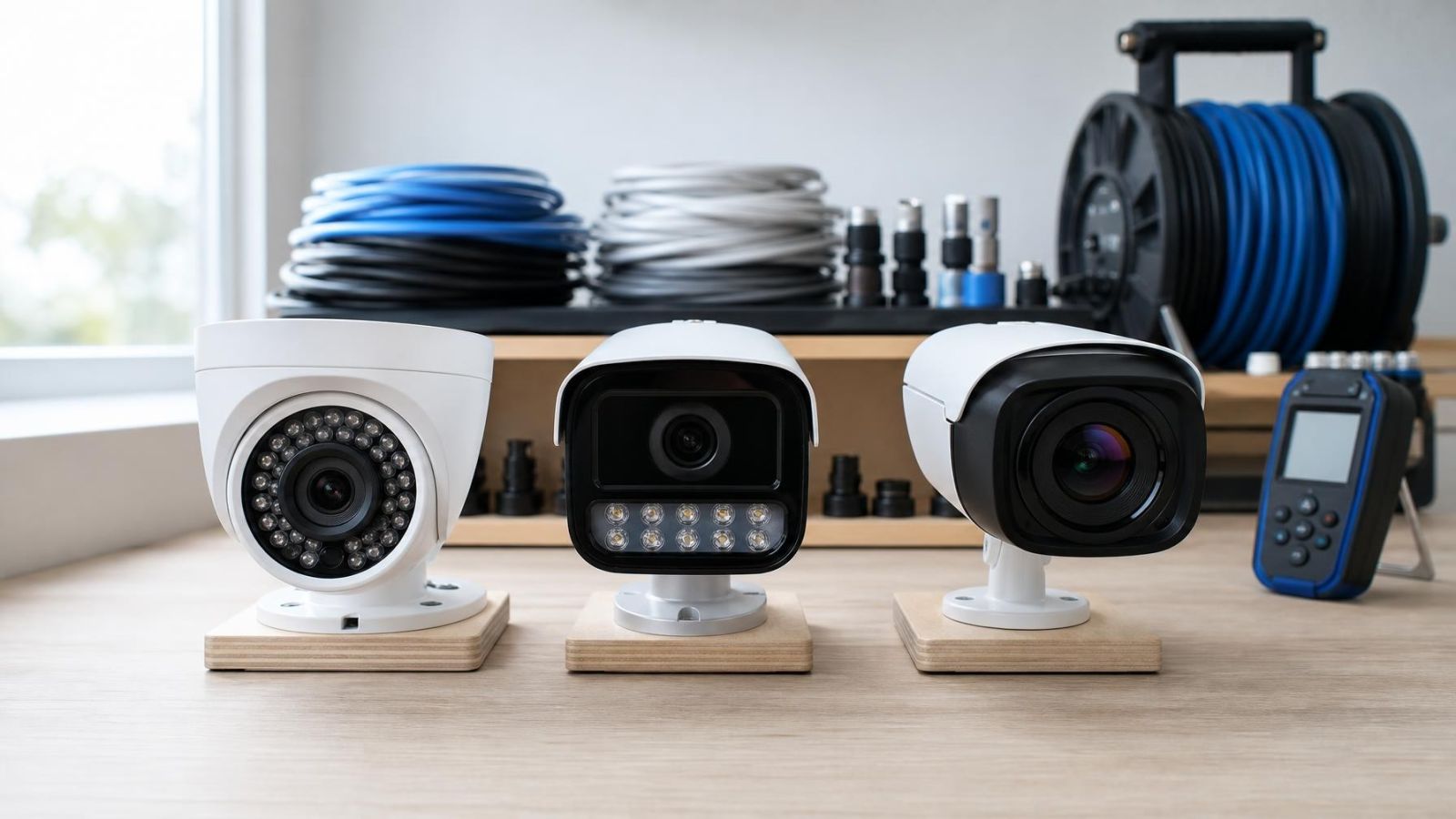
At an outdoor entrance, an infrared security camera, a white light camera and a low-light colour camera may produce very different recordings. One uses infrared illumination. Another uses an integrated spotlight. The third depends mainly on ambient lighting. Among the main night vision camera types, the right choice is the one that records the detail you need without creating unwanted light, reflection or blur at that particular position.
The labels can make these technologies sound more interchangeable than they are. All three can show a scene after dark, but they do not create the image in the same way. The difference becomes important at gates, gardens, apartment entrances and street-facing businesses, where available light can vary sharply across a single frame.
How does an infrared security camera work?
Infrared (IR) illuminators project light that the image sensor can use even though it does not create a conventional visible spotlight. When the camera enters night mode, it usually changes to a black-and-white image. Removing colour allows the camera to make better use of the available infrared illumination and record useful shapes, edges and movement in deep darkness.
A white light unit illuminates the scene with visible light. This lets the camera retain colour information for clothing, vehicles, gates and objects. The practical trade-off is equally visible: people nearby can see the light, and it may enter windows or affect how occupants use the area.
What is a color night camera?
The search term color night camera usually refers either to a camera with white light or to a low-light colour camera. They are not the same. A low-light model uses ambient lighting from sources such as garden fittings, entrance lights or street lighting. As that light weakens, image noise rises and moving subjects can blur. It cannot create useful colour from complete darkness without another source of visible light.
Many cameras switch automatically between day and night modes. The switching point matters. A camera facing a changing light source may alternate between colour and monochrome, especially around a doorway or vehicle entrance. Sensitivity and switching-delay settings, where available, should be checked after installation rather than left unexamined.
Which Night Image Do You Need?
Start with the decision the recording must support. If vehicle colour, clothing colour or the difference between similarly shaped objects matters, a colour image may be useful. If visible illumination is unwanted and the scene becomes genuinely dark, clear monochrome detail may be the better result.
Scene context and fine subject detail are separate requirements. A wide view can show where a person came from, which gate opened and what route was taken. A tighter view can place more pixel detail on a face, parcel or vehicle. Changing the night technology does not compensate for a subject that is too small in the frame.
- For a garden overview, prioritise stable exposure and readable movement across the whole scene.
- For a gate or doorway, prioritise the subject at the expected distance rather than the brightness of the background.
- For vehicles, check body colour and general features separately from highly reflective surfaces.
- For live viewing, consider whether an occupant can interpret the scene immediately on a small screen.
- For recorded review, test paused frames of moving subjects rather than judging only a smooth live stream.
A bright lamp, illuminated sign or headlight in the frame can reduce detail in darker areas. WDR (wide dynamic range) can help manage strong contrast, but it does not remove the need for a sensible angle. The most attractive daytime composition may not be the most useful night composition.
Choose the night image by the decision it must support, not by which demonstration looks brightest.
Infrared Strengths and Trade-Offs
Infrared is often the practical choice where no dependable visible lighting exists. It gives the camera its own illumination and does not wash a garden, corridor or entrance with a visible spotlight. In a well-planned position, it can provide consistent monochrome recording without changing how people experience the space.
The main difficulties are caused by reflected infrared. Glass can send the camera's own illumination back towards the lens, obscuring the view beyond it. A pale wall, soffit, column or drainpipe close to one side of the frame can also become intensely bright. The camera then reduces exposure for that bright surface, leaving the actual subject darker.
A face very close to a strong illuminator can lose tonal detail for the same reason. Quoted illumination range is not enough to assess this. The subject distance, beam direction, camera angle and reflectivity of nearby materials all change the result.
Insects and webs near the camera can become bright, moving shapes because they sit close to the illuminator. Plants can do something similar when leaves move in the foreground. These effects can also create unnecessary motion detection events. Sensible clearance and routine cleaning matter more at night than daytime viewing suggests.
The final trade-off is colour. Once the camera changes to infrared monochrome, colour information is no longer available. A dark jacket and a coloured jacket may appear similar even when their daytime appearance is clearly different.
White Light Versus Low-Light Colour
When should you use a white light camera?
Use white light where colour is important and visible illumination is acceptable. An integrated spotlight provides its own lighting, so the camera does not depend entirely on a shared corridor lamp or a garden light that someone may switch off. It can run continuously at night or activate through motion detection, depending on the required behaviour and the equipment settings.
Continuous illumination gives the camera a more stable scene, but it also changes the appearance of the property throughout the night. Motion-triggered light reduces the time it remains on, although the recording may begin while exposure is still adjusting. It can also activate for ordinary movement such as residents arriving, passing traffic at a street frontage or branches entering the detection area.
Visible light needs to be considered from outside the camera view as well. A spotlight that looks modest on a monitor may be noticeable from a bedroom, a neighbouring balcony or the apartment opposite a shared entrance. Direction and mounting height are therefore part of the choice, not finishing details.
Low-light colour is less intrusive because it uses lighting already present in the environment. Under a well-positioned entrance light or steady street illumination, it can retain useful colour without adding another visible source. Uneven lighting remains a problem: a bright pool beneath a lamp does not necessarily illuminate the face of someone approaching from a darker area.
| Night method | Light source | Typical night image | Main limitation |
|---|---|---|---|
| Infrared | Built-in or separate IR illumination | Monochrome | Reflections and loss of colour |
| White light | Visible integrated or external light | Colour | Light is visible to people nearby |
| Low-light colour | Existing ambient lighting | Colour while usable light remains | Noise and blur increase as the scene darkens |
In very dim scenes, a low-light camera may lengthen exposure or apply stronger image processing. A stationary garden can then look impressively bright while a walking person appears soft or blurred. Night evaluation should include movement at the intended subject distance, not only an empty scene.
What Changes in Israeli Properties?
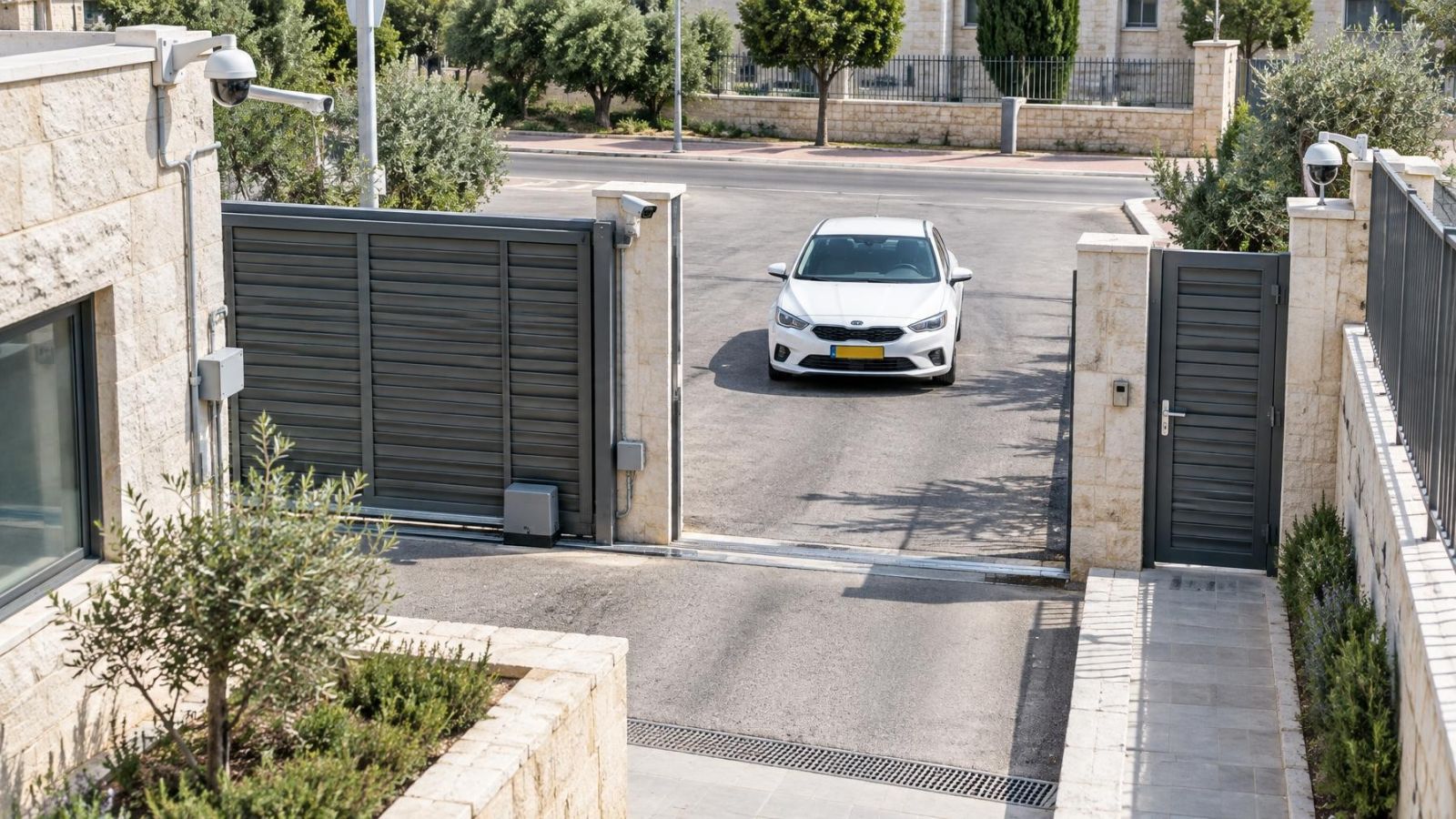
Israeli properties often combine intense daylight with difficult night contrast. A camera at a private gate may face a bright street while the path inside the garden is dark. A street-front business may have illuminated signs outside and an unlit interior behind glass. At these positions, WDR, exposure settings and camera direction all matter, but careful framing remains the first tool.
Dust gradually softens daytime images and can severely degrade night images when illumination reflects from the dirty cover. Coastal humidity can add condensation or a thin residue. Cleaning access should be considered when selecting the mounting point; a camera that cannot be reached safely is less likely to receive routine attention.
Apartment-building entrances add shared lighting to the calculation. The entrance light may be controlled centrally, by a timer or by a sensor. A night survey should confirm what remains illuminated when the building is quiet. Decisions about visible spotlights should also be coordinated with the va'ad bayit because the light affects a shared space, even when the camera serves one apartment.
Glass requires particular care at shopfronts and enclosed balconies. A camera mounted behind glass should not use its own infrared through the pane. Reflections from indoor lights and objects behind the camera can also dominate the image. Mounting outside the glass, changing the angle or using separate illumination on the subject side usually produces a cleaner scene.
A mamad, or safe room, is a normal part of many Israeli floor plans. Its substantial walls can complicate wireless connections and cable routes between the camera, network and recorder. Test the connection through the actual route rather than assuming that a nearby indoor position will communicate reliably. PoE (power over Ethernet) cabling can provide both data and power where a suitable cable route is practical.
Gardens bring another set of reflections. Pale stone, rendered walls and light paving can return a large amount of IR or white light. Leaves near the lens can appear much brighter than the gate or path beyond them. Seasonal growth should be considered, not only the garden's condition on installation day.
Choose by Scene, Not Label
A property does not need one night technology everywhere. Infrared may suit a dark side passage. Low-light colour may suit a covered entrance with dependable lighting. White light may be appropriate at a gate where colour matters and the beam can be directed without disturbing nearby rooms. Mixed camera types are often more coherent than forcing one mode onto every position.
The selection process should happen at night from each proposed mounting point. Daytime inspection can identify cable routes and fields of view, but it cannot show which lamps remain on, where reflections appear or how much ambient light reaches a moving subject.
- Define what each camera must show: general activity, a route, a doorway, a person at a known distance or vehicle characteristics.
- Observe the scene after homes settle for the night or after a business closes, when temporary interior and display lighting is no longer helping the image.
- Check for glass, pale walls, metal surfaces, plants and low ceilings near the proposed lens and illuminator.
- Decide whether continuous or motion-triggered visible light is acceptable to occupants, neighbours and users of shared areas.
- Install at the intended height and angle, then record people and vehicles moving through the relevant parts of the scene.
- Review the stored footage through the NVR (network video recorder), DVR or VMS (video management software), including paused frames, before finalising exposure, motion detection and night-switching settings.
Testing recorded footage is important because live viewing can conceal brief blur, switching delays and compression artefacts. Check the same scene with nearby lights on and off where those states are part of normal use. Also confirm that remote viewing shows the camera's real night behaviour rather than only a convenient daytime sample.
The best installation is not the one with the brightest specification or the longest claimed illumination range. It is the one whose light source, angle and night mode match the scene. Treat every camera position as a separate lighting problem, then connect those positions into one practical system.
Key takeaways
- Infrared provides discreet monochrome viewing in deep darkness without using a visible spotlight.
- White light supports colour recording but is visible to occupants, neighbours and people entering the scene.
- Low-light colour works best where ambient lighting is dependable and correctly positioned.
- Different camera positions on the same property may require different night modes.
- Night recordings should be tested from the final mounting position under the lighting conditions that will actually remain after closing or bedtime.