On this page
A PoE camera depends on more than a network connection. The route includes a solid copper Ethernet cable or a copper-clad aluminium cable, a PoE switch, an outdoor cable jacket where exposed, and a network connector at each end. The practical question is which combination can carry camera data and electrical power dependably from the switch to the installed position. For fixed camera wiring, solid copper conductors are the clear default.
What the cable must carry
PoE (power over Ethernet) sends network data and electrical power through the twisted pairs in one cable. Those pairs are not merely convenient bundles of wire. Their conductor material, size, twist and termination all affect how the link behaves.
The PoE switch supplies power at one end. The camera receives what remains after losses along the cable, connectors and any intermediate joins. A short indoor route to a modest fixed camera is relatively undemanding. A longer route to a gate, garden wall or street-facing camera leaves less room for poor conductors and weak terminations.
Camera demand also changes during operation. IR illumination, heaters, microphones, speakers or motorised functions can draw additional power when active. A cable may therefore pass data during a quick test but behave differently when the camera is using more of its powered features.
- Cable length influences the total resistance between the PoE switch and camera.
- Conductor gauge affects resistance, but gauge alone does not reveal the conductor material.
- Every connector, coupler and patch lead becomes part of the complete powered path.
- A continuity result confirms connected wires; it does not show how the route behaves under electrical load.
Solid copper and CCA compared
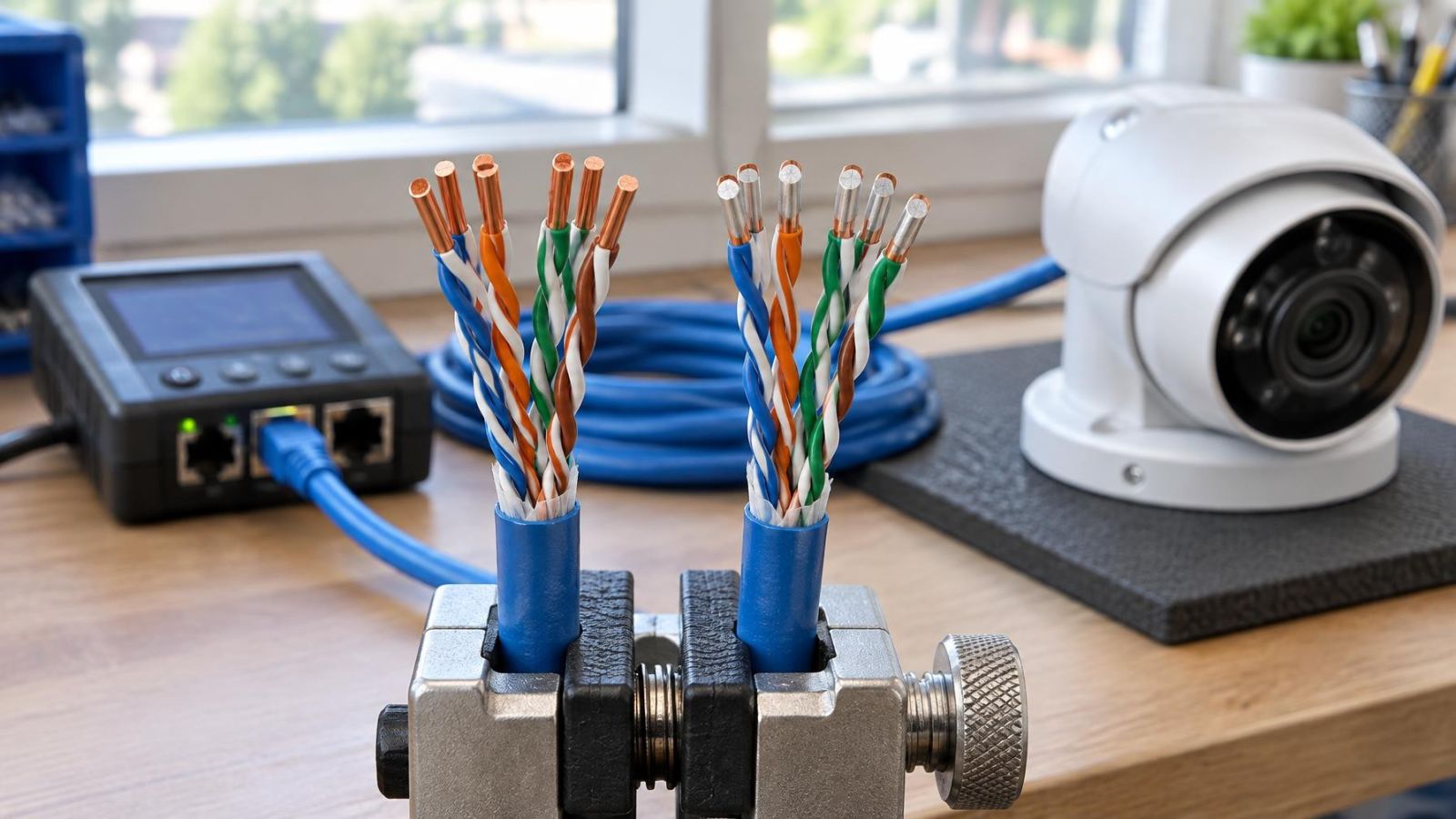
A solid copper conductor is copper throughout its cross-section. Copper-clad aluminium, commonly shortened to CCA, has an aluminium core with a copper coating. The cut surface can look copper-coloured around the edge while showing a pale metallic centre.
For conductors of comparable size, solid copper has lower electrical resistance. That matters because higher resistance creates more voltage drop and heat when the cable carries power. The longer the run and the greater the camera demand, the more important the difference becomes.
| Attribute | Solid copper conductor | Copper-clad aluminium conductor |
|---|---|---|
| Core material | Copper throughout | Aluminium core with copper coating |
| Electrical resistance | Lower for comparable conductor size | Higher for comparable conductor size |
| Powered cable behaviour | Better suited to fixed PoE camera routes | Greater voltage drop and heating under load |
| Termination | Mechanically robust when matched to the connector | More vulnerable to damage or poor contact during termination |
| Identification | Requires clear material documentation | May be presented using unclear descriptions such as solid network cable |
The word solid needs care. It describes conductor construction: one wire rather than a bundle of fine strands. It does not identify the metal. A cable can have solid CCA conductors. Likewise, a flexible patch lead can use stranded conductors made from copper. The useful written description is therefore solid bare-copper conductors for fixed cabling, not simply solid cable.
Cable category, conductor construction, conductor material and jacket type answer four different questions. None should be used as a substitute for another.
Which PoE camera cable type should you choose?
For concealed or fixed PoE camera runs, choose twisted-pair cable with solid copper conductors. It gives the installer a predictable basis for power delivery, termination and future testing. The cable category still needs to suit the network design, but a category marking does not by itself confirm copper conductor material.
Is solid copper Ethernet the right default?
Yes, for permanent camera wiring. Routes above ceilings, through walls, across a mamad or safe-room boundary, and underground towards a gate are inconvenient to replace. The cable is infrastructure, not a disposable accessory. Using suitable copper conductors from the start removes one avoidable source of voltage drop and termination difficulty.
CCA cable cameras can appear to operate normally on a bench or short route. That does not make CCA a sound choice for a concealed powered installation. The concern is not data alone. The same conductors must deliver power while the camera is operating, including when IR or other powered functions are active.
Does the same rule apply to patch leads?
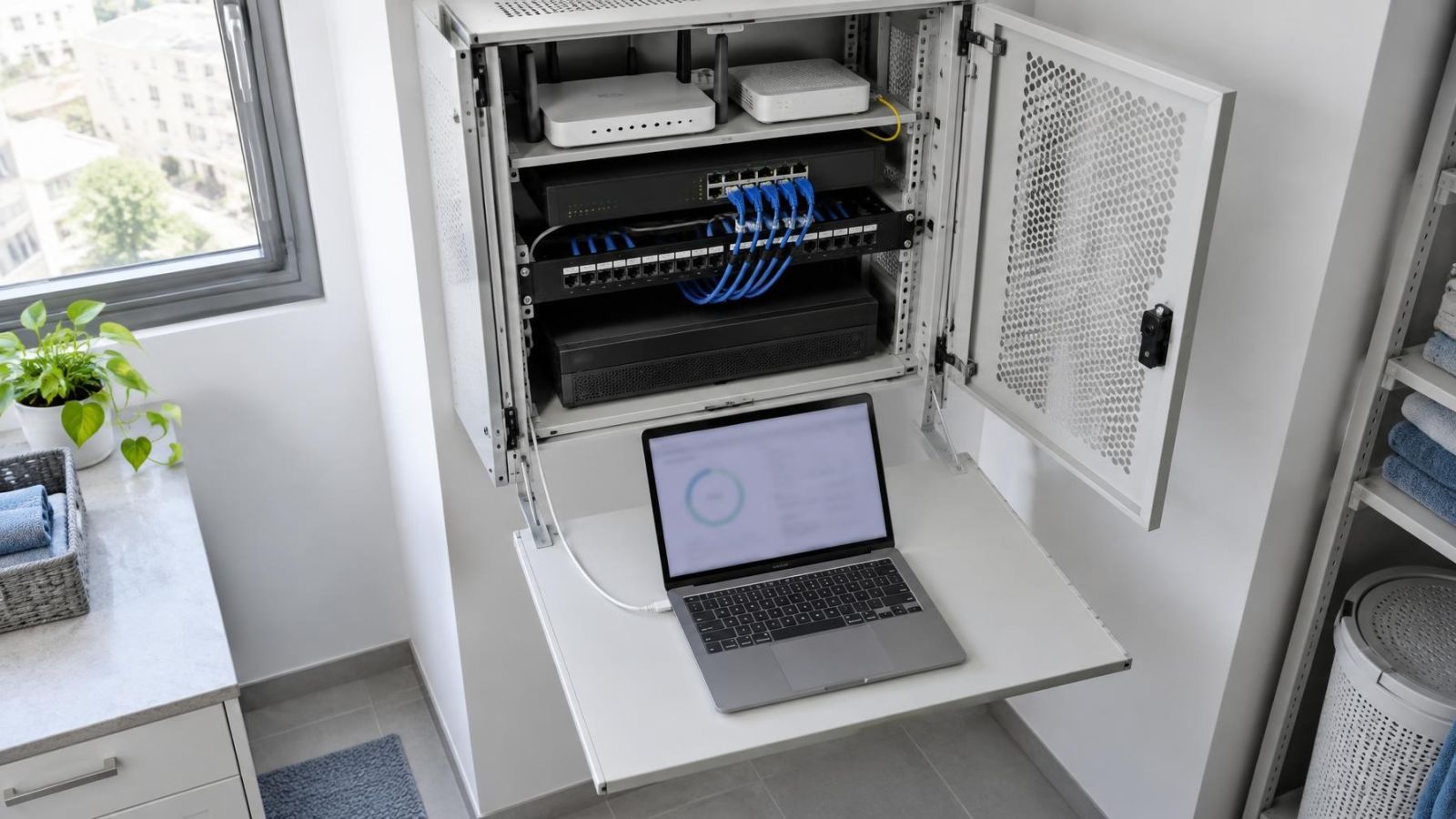
A short patch lead inside a protected cabinet has a different mechanical job from fixed cable. Patch leads are often flexible because their conductors are stranded. Flexibility is useful between a PoE switch and patch panel, but the conductor material should still be copper. Do not confuse stranded copper with CCA, or assume that every flexible lead has the same electrical properties.
How can you identify CCA cable?
Start with the printed cable legend, reel label and supplier documentation. Look for a direct statement of conductor material. Phrases such as high performance, premium, solid, professional or outdoor do not answer the question. Ask whether the conductors are copper throughout, rather than asking only whether the cable contains copper.
A cleanly cut conductor can provide a useful warning sign. CCA often reveals a silver-coloured centre beneath the copper-coloured surface. Scraping the conductor may expose the lighter core. Visual inspection is not a substitute for reliable documentation, but it can catch a mismatch before a cable disappears into conduit or plaster.
- Check the cable printing and packaging for an explicit conductor-material description.
- Retain a piece of the cable legend or the labelled reel until the installation is handed over.
- Compare the delivered product with the written specification before pulling any route.
- Treat an unexpectedly light reel as a reason to investigate, not as proof on its own.
- Request direct written confirmation from the supplier if the wording is incomplete or ambiguous.
Material verification belongs at the beginning of the work. Once connectors are fitted, labels discarded and cable concealed, identification becomes slower and less certain. A small offcut showing both the jacket printing and conductor cross-section can be retained with the installation records.
Outdoor routes need more than copper
Solid copper conductors do not make an indoor cable suitable for outdoor exposure. The outer jacket has a separate job: protecting the cable from sunlight and environmental conditions. Conversely, the words outdoor cable do not confirm that the conductors are copper. Both requirements must be stated.
Israeli installations commonly include strong sunlight, hot external walls, dust, and coastal humidity. Camera routes may leave a building for a garden wall, entrance gate, car park or street frontage. The jacket, conduit and entry details must suit the actual route rather than the room where the cable begins.
- Use a sunlight-resistant outdoor cable jacket wherever the cable remains exposed.
- Plan conduit bends and entry points so water is not guided towards the camera, connector or building interior.
- Avoid treating conduit as a guarantee of dryness; condensation and water entry still need consideration.
- Protect low-level garden and gate routes from pulling, crushing and maintenance work nearby.
- Provide weather protection for connectors instead of leaving a plug-and-socket joint exposed.
- Consider dust and salt-laden coastal air when choosing enclosures and planning service access.
The cleanest arrangement is usually an uninterrupted fixed cable from the protected network location to a weather-protected termination near the camera. Where a join is unavoidable, it should remain accessible. Burying a connector inside a wall or inaccessible conduit turns a replaceable component into a fault that is difficult to locate.
Connectors and termination matter
Good cable can be undermined by the wrong network connector. Contacts intended for stranded conductors do not necessarily engage a solid conductor in the same way, and conductor diameter can vary between cable constructions. The connector, cable and termination method must be compatible.
Pair twists should be maintained as close as practical to the termination. Excessive untwisting creates avoidable data problems, while poor seating or partial contact can affect both data and power. A correct tool applies the intended pressure without crushing the plug or leaving contacts incompletely seated.
At the camera end, strain relief matters. The cable should not hang from the connector or pull sideways on the camera socket. Outdoors, the weather seal must fit the actual cable diameter. A loose seal can admit moisture; an overtightened or improvised seal can damage the jacket.
Why test with the camera powered?
A basic wire-map or continuity test is useful, but it is not the final test for a PoE route. The completed link should be checked while the intended camera is powered and communicating. Powered features should be exercised where practical, including IR night vision if it is part of normal operation.
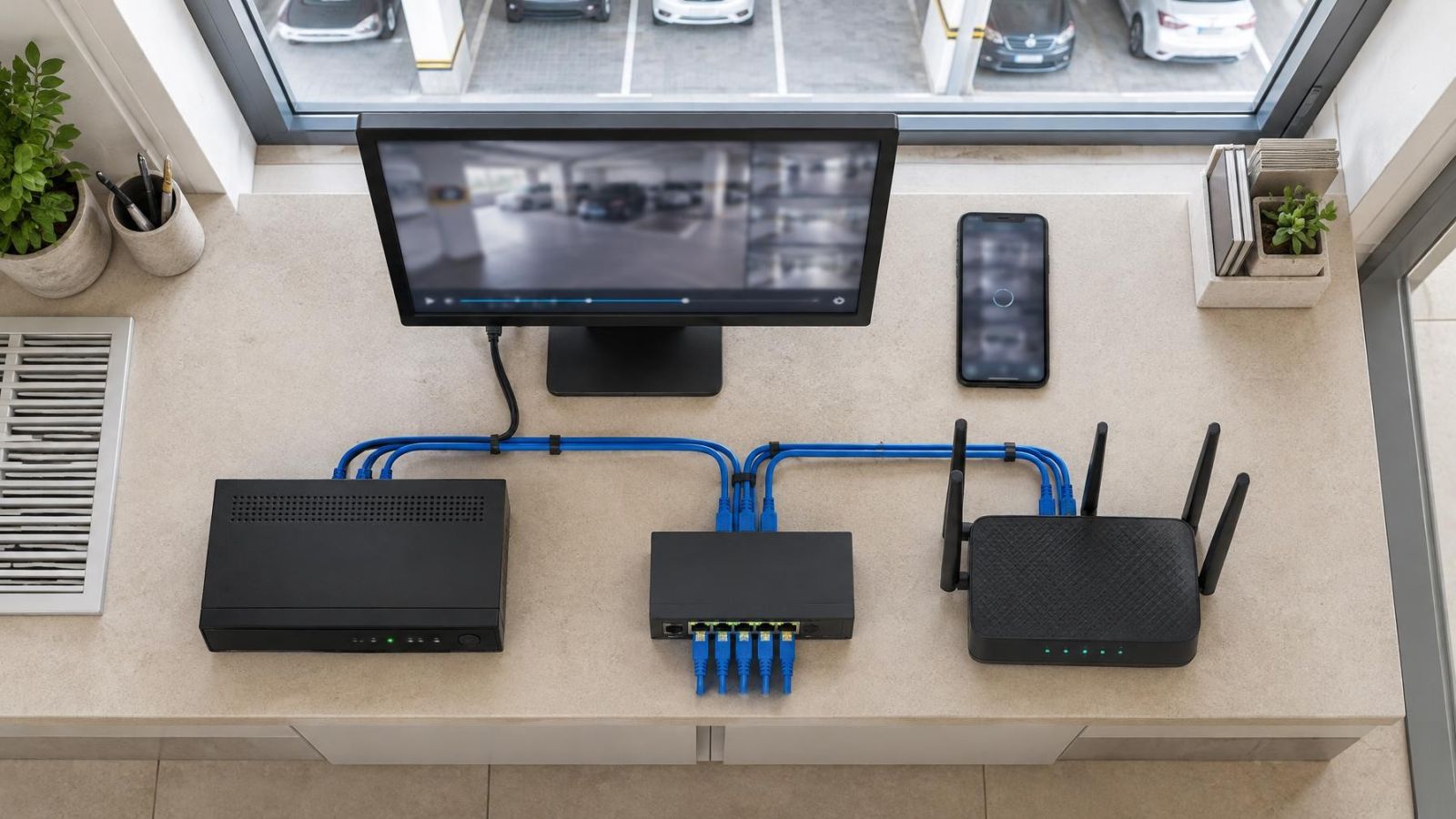
The installer should also check the live video stream through the NVR (network video recorder) or VMS (video management software), not only the local connector LEDs. This verifies the route as a system: switch port, patch leads, fixed cable, terminations and camera.
Specify the cable before installation
A useful specification is short but explicit. It identifies the conductor material, construction, jacket and route conditions. It also says how the completed work will be checked. Leaving these points implicit makes it easier for visually similar cable to be substituted without anyone recognising the change.
- Write that fixed PoE camera cabling requires solid bare-copper conductors, not copper-clad aluminium.
- State where an outdoor, sunlight-resistant jacket is required, including any exposed sections between conduit and equipment.
- Review the complete route from the PoE switch to each camera, including patch leads, panels, couplers and outdoor transitions.
- Keep the reel label, cable legend or a labelled offcut on site until the installed material has been confirmed.
- Test each completed run for data and power with the intended camera operating before handover.
For remote property owners, installation records are especially useful. A clear cable schedule, route description and retained material identification allow a future technician to understand what is inside the walls without relying on memory. For a small business, the same records make changes at the network cabinet more controlled.
The final decision is straightforward: use solid copper twisted-pair cable for fixed PoE camera routes, add the correct outdoor jacket wherever exposure requires it, terminate with compatible components, and test under load. Those are separate choices, and the installation is only as dependable as the way they are combined.
Key takeaways
- Solid copper twisted-pair cable is the dependable default for fixed PoE camera wiring.
- Conductor material must be specified separately from cable category, conductor construction and jacket type.
- An exposed camera route needs both suitable copper conductors and an outdoor cable jacket.
- A completed camera cable should be tested for data and power delivery with the camera operating.
- A written cable specification makes unintended substitution with copper-clad aluminium less likely.